A-Ads

Showing posts with label Agorism. Show all posts

Saturday, November 22, 2025

Embracing Voluntaryism: The Foundation of True Freedom in a Coercive World

Embracing Voluntaryism: The Foundation of True Freedom in a Coercive World

In a society dominated by state mandates, voluntaryism offers a refreshing alternative: a philosophy where all interactions are consensual, free from coercion. Closely tied to positive anarchy, agorism, and libertarianism, it promotes peaceful, voluntary exchanges as the path to liberty.

Key Principles

Voluntaryism rejects initiated force, emphasizing self-ownership and non-aggression. Agorism takes it further by advocating counter-economics—black and gray market activities to undermine the state. Positive anarchy focuses on building voluntary communities without rulers, proving society thrives on cooperation.

Practically, this means using cryptocurrencies for untaxed trades, forming mutual aid networks, and opting out of coercive systems. In 2025, with rising surveillance, these ideas are more relevant than ever.

Start small: Trade services with friends tax-free or explore agorist markets. True freedom begins with choice.


Learn more from books like "The Market for Liberty" – available on Amazon.


Saturday, November 8, 2025

Embracing Freedom: Exploring Positive Anarchy, Voluntaryism, and Agorism

Embracing Freedom: Exploring Positive Anarchy, Voluntaryism, and Agorism

In a world dominated by centralized systems, concepts like positive anarchy, voluntaryism, and agorism offer refreshing paths to true freedom. These philosophies emphasize individual liberty, mutual consent, and counter-economics without coercion. Let's break them down and see how they can empower your life.

Positive Anarchy

Far from chaos, positive anarchy is about voluntary cooperation and self-governance. It rejects forced hierarchies in favor of peaceful, community-driven solutions. Think of it as living free from unnecessary rules while respecting others' rights.

Voluntaryism

At its core, voluntaryism asserts that all interactions should be consensual. No government or authority should impose taxes or laws without agreement. It's a philosophy of peace, promoting alternatives like private arbitration and mutual aid societies.


Agorism


Coined by Samuel Edward Konkin III, agorism involves building a free market underground—counter-economics—to starve the state of resources. This includes black and gray market activities, cryptocurrencies, and bartering to create a society based on voluntary exchange.

These ideas aren't about rebellion for its own sake but about creating sustainable, ethical alternatives. In 2025, with rising interest in decentralized tech like blockchain, they're more relevant than ever. Explore books like "For a New Liberty: The Libertarian Manifesto" by Murray Rothbard, for deeper insights..

What steps will you take towards living free today?

Monday, July 1, 2024

Cryptocurrencies and Freedom: A Beginner's Guide to Financial Independence - Part 1


Greetings, fellow freedom-seekers! Today, we're diving into the fascinating world of cryptocurrencies and how they can help you achieve financial independence. If you're tired of the traditional financial system and want to take control of your own financial destiny, this post is for you.


What are Cryptocurrencies?

Cryptocurrencies are digital or virtual currencies that use cryptography for security and operate independently of a central bank. The most famous example is Bitcoin, but there are thousands of other cryptocurrencies out there, each with its own unique features and purposes.

Why are Cryptocurrencies Important for Financial Independence?

  1. Decentralization: Cryptocurrencies are decentralized, meaning they are not controlled by any government or financial institution. This gives you the freedom to transact without the need for intermediaries, reducing fees and increasing privacy.
  2. Security: Cryptocurrencies use advanced cryptographic techniques to secure transactions and control the creation of new units. This makes them more secure than traditional forms of payment, reducing the risk of fraud and identity theft.
  3. Global Accessibility: Cryptocurrencies can be accessed by anyone with an internet connection, regardless of their location or financial status. This makes them an ideal tool for promoting financial inclusion and empowering individuals in underserved communities.
  4. Inflation Protection: Many cryptocurrencies, like Bitcoin, have a limited supply, which can protect your wealth from inflation caused by the devaluation of traditional currencies.
  5. Investment Opportunities: Cryptocurrencies have the potential to generate significant returns on investment. However, they are also highly volatile, so it's important to do your research and invest wisely.

How to Get Started with Cryptocurrencies

Ready to take the plunge into the world of cryptocurrencies? Here are some steps to get you started:

  1. Educate Yourself: Learn about the different cryptocurrencies available, their features, and the technology behind them. Understanding the basics will help you make informed decisions.
  2. Choose a Wallet: A cryptocurrency wallet is a secure digital wallet used to store, send, and receive digital currency. Choose a wallet that supports the cryptocurrencies you want to use and has a good reputation for security.
  3. Buy Your First Cryptocurrency: You can purchase cryptocurrencies on various online exchanges using traditional currency or other cryptocurrencies. Make sure to choose a reputable exchange and follow theirKnow Your Customer (KYC) and Anti-Money Laundering (AML) procedures.
  4. Secure Your Investment: Keep your cryptocurrency safe by enabling two-factor authentication on your wallet and exchange accounts, and consider using a hardware wallet for added security.
  5. Stay Informed: Keep up-to-date with the latest news and developments in the cryptocurrency world, as this can have a significant impact on the value of your investments.

By following these steps and taking a cautious approach, you can begin your journey towards financial independence using cryptocurrencies. Remember, the key to success is to stay informed, be patient, and never invest more than you can afford to lose. Happy investing!

Monday, May 20, 2024

The Art of Agorism: How to Practice Counter-Economics in Your Daily Life


Greetings, fellow freedom-seekers! Today, we're diving into the fascinating world of agorism, a

philosophy and practice that aims to create a freer society by engaging in voluntary exchanges and counter-economics. If you're tired of the status quo and want to live a life that minimizes your entanglement with the government, this post is for you.

What is Agorism?


Agorism is a social philosophy that advocates for a society based on voluntary exchanges and the creation of a free-market anarchist system. It was developed by philosopher Samuel Edward Konkin III in the 1970s. The term "agorism" comes from the Greek word "agora," which means "marketplace."

The Counter-Economy: A Brief Overview

The counter-economy is the underground or "black" market where individuals engage in voluntary exchanges without the interference of the state. This includes everything from bartering and using cryptocurrencies to participating in the sharing economy and engaging in other forms of non-coercive trade.

Practicing Agorism in Your Daily Life


Ready to start living the agorist life? Here are some tips and ideas to get you started:


Embrace Cryptocurrencies:
Start using cryptocurrencies like Bitcoin and Ethereum for your daily transactions. Not only do they provide a level of anonymity, but they also help you avoid the traditional banking system and its associated fees.

Forget trying to trade in and out of crypto, hoping to flip coins to gain dollars or other government fiat.  Abandon government fiat as much as possible.  Remember, Central Bank currencies are inflationary and are heading to zero eventually.  Don't think about using Bitcoin or Ethereum to make money - they ARE the money.  Use your Federal Reserve Notes to make Bitcoin, not the other way around!

Support the Sharing Economy: Participate in platforms like Airbnb, Uber, and TaskRabbit. These services allow you to share resources and skills with others without the need for government intervention.

Barter and Trade: Get involved in local bartering networks or online platforms that facilitate the exchange of goods and services without the use of traditional currency.

Grow Your Own Food: Start a small garden or join a community garden to grow your own fruits and
vegetables. This will help you become more self-sufficient and reduce your reliance on the government-regulated food industry.

Educate Yourself and Others: Learn more about agorism, voluntaryism, and other related philosophies. Share your knowledge with friends and family to help spread the word about peaceful, voluntary alternatives to the current system.

Engage in Skill-Sharing: Offer your skills and talents to others in exchange for their services or goods. This could include anything from tutoring and web design to carpentry and cooking.

Use Open-Source Software: Opt for open-source software and platforms whenever possible. This not
only supports the free exchange of ideas but also helps you avoid proprietary software that may come with hidden costs and restrictions.

Remember, that agorism is about the free flow of ideas and exchanging actual products and services.  Intellectual Property is generally not incorporated into these ideas as they require constant policing, invasions of privacy, and new definitions to the ideas of theft or property, that are not congruent with a free society.  

By incorporating these practices into your daily life, you'll be taking meaningful steps towards living a freer, more voluntaryist existence. Remember, agorism is a journey, and every small action counts. So, go forth and practice counter-economics with a smile on your face and a rebellious twinkle in your eye!

What do you think of this list?  Of course there are many more ways to practice living free that are not included.  What are your favorites?  Leave your ideas in the comments!

Tuesday, August 16, 2016

Woman Arrested for Selling Tamales

This woman is fighting for your freedom.  
While the troops, police, and government officials continue to take it away.

Warrant Issued for Mother’s Arrest for Selling Homeade Tamales to Her Neighbors


Read more at http://thefreethoughtproject.com/police-arrest-mother-tamales/#eUllujRmmgx7ZGk2.99
Carrollton, TX — In modern day police state, USA, exchanging goods and services is a crime unless the state gets their cut. So, even though a Carrollton mother was “stunned” to find a warrant issued for her arrest for selling tamales to her neighbors — it was to be expected.

This week, Dennise Cruz was shocked to receive a yellow postcard from the City of Carrollton stating that if she doesn’t immediately submit to their extortion demands, then she would be kidnapped and locked in a cage.

“That has to be wrong. I don’t have any tickets under my name. That’s just my first reaction. Never would have I thought, tamales,” said Cruz in an interview with CBS DFW. “To know that somebody can be arrested over that, that to me is unbelievable.”.

The yellow ticket was a “warrant arrest notice” stemming from Cruz’ illegal activity a few months prior. Cruz, obviously a hardened criminal worthy of police action, decided to make her famous tamales and post them on the app Nextdoor for sale. Her neighbors loved them.

“It’s just so common. That’s why to me, I don’t understand why it’s such a big deal,” said Cruz.
However, because Cruz did not pay the state to operate this business, their procedure is to rob her under the threat of violence. She was hit with a $700 fine.

“When it hit me, I was like that is a lot of money,” said Cruz.

When Cruz called the city to protest her extortion, the clerk told her that someone reported her for not having a food permit. However, this is not likely as only the government would know such things.
“I don’t understand because if anything I would have rather them come to me first if they had any concerns,” said Cruz.

The city of Carrollton maintains that extorting Cruz is in the interest of the people. According to a city director, tamales are a danger to society. A director said a fine was issued and not a warning because tamales are considered “potentially hazardous food” due to the cooked corn and meat being used, according to CBS DFW.


“I’ve seen so many people doing it. And unfortunately it’s me who’s having to deal with it,” said Cruz. “I’d just rather stay away from that at the moment, making tamales.”

The good news is Cruz intends to fight this tyranny in court. Also, friends set up a GoFundMe account for her that’s made more than quadruple the amount she needs just to pay the fine — highlighting that Americans can’t stand this ridiculousness either.


This absurd arrest warrant comes on the heels of an equally asinine incident, also in Texas, in which two young girls had their lemonade stand shut down by local cops for not having the correct permit. The good news is that, like Cruz, the girls refused to roll over and opened their stand up again the next weekend.

Apparently, Texas officials take their motto Don’t Mess with Texas quite literally. Aside from threatening to arrest a young mother attempting to make ends meet by selling tamales and shutting down little girls’ lemonade stands, they’ll also throw you in a cage for having tall grass on your own property.

Don’t take our word for it, however. Ask 75-year-old Gerry Suttle, who was stunned when she received a call from the local police chief, informing her that she had a warrant issued for her arrest — because her grass was at a length not desirable for the state of Texas.

In April of last year, another Texas resident, Rick Yoes, was sentenced to 17 days in jail for the length of his grass.

And some folks still have the gall to call this country the Land of the Free. 

Monday, September 1, 2014

Fully-Distributed Disruptive Technologies Set to Break Up Big Conglomerates and Monopolies


The key to government control of an industry sector is regulation of large corporations that are the backbone of that industry.  For example, you buy electricity from a local provider.  That provider is a regional monopoly that is highly regulated by the government.  The monopoly enjoys a guaranteed profit without any risk.  Large companies love government regulation because it socializes their risks and they earn guaranteed profits.  This rent-seeking behavior is the driving force of monopolization.

Local electricity providers name their price, and you have no choice but to pay it, for this reason monopolistic businesses are called Price Setters.

In free markets, businesses must sell for what the market is willing to pay since there are many competitors vying for the sale, for this reason businesses operating in a free market are called Price Takers.  Free markets are the exact opposite of a monopoly.  Free and unregulated markets have not really existed in this country for quite a long time (think centuries), but now with the advent of Fully-Distributed Networks, we are starting to see them return and there is nothing the government can do to stop it.

Using our electrical monopoly example...  the monopoly enterprise must generate the power, then distribute it to their customers many of whom are located many miles away.  Transmitting electricity over long distances like this creates losses due to the inefficiency (impedance in transmission lines).  The consumer must pay for these inefficiencies as well as tolerate any regulations that are placed on them in order to guarantee the profits to the utility company.  Those regulations are getting more and more intrusive with lightbulb restrictions, the increased usage of Smartmeters, remote air conditioner cycling, etc.

Now imagine that you had a device in your backyard (and/or on your roof) that produced all the
The DFC300 Fuel Cell pictured here can provide power to 250 homes
electricity you needed, perhaps a combination of fuel cell, solar, and wind technologies.  There would be virtually no transmission losses since the distance to your house is very short.  You have just become a threat to the local monopoly.  Now imagine that everyone had them.  The monopoly would cease to exist despite their guarantee of profit from the government.  This form of peaceful rebellion is spreading through many industries, and for this reason, Fully-Distributed Networks are often referred to as "Disruptive Technologies".

Microgrids are another type of disruptive technology that is on the rise throughout the world.  These usually incorporate a power plant that can power a small neighborhood, office building, or residential development.  Several companies can operate small electrical utility networks that compete against each other.

Larger fuel cells or solar/wind stations can be used for whole neighborhoods.  Imagine if you had the option to buy power from one of several providers or your Home Owners Association.  That freedom of choice in providers that the consumer enjoys forces those utility companies to compete by lowering prices and improving service.


Bitcoin is one of the biggest currently growing and spreading throughout the world and it seeks to destroy or disrupt national and world banking cartels such as the Federal Reserve Bank and International Monetary Fund.


Open Source Development is another example.  Historically, inventors and manufactures sought protection of their ideas from competition in the market through the obtaining of a patent by the government.  The patent grants the inventor a temporary monopoly on their invention for a period of time.  Other companies are not allowed to infringe on the invention without a licensing agreement which usually involves paying a licensing fee plus royalties.

Companies will spend billions of dollars protecting their patents by suing other companies and small inventors for patent infringement.  This behavior wastes resources that could be spent on innovating and improving their existing designs, and also discourages others from making improvements to existing inventions.  Many small inventors are put off by the expense of needing to hire a lawyer to do a patent search before proceeding with their invention, so they are defeated before they even begin.

So, along comes Open-Source Development.  Open-Source Development is a development strategy that does not seek patents, copyrights, or other intellectual property protections.  In fact it encourages competitors to co-develop a product by providing all blueprints, schematics, design documents, software code, etc. to the public free of charge.  Companies that use this development strategy have seen massive increases in the speed of  product improvement, growth in sales, and a massive decrease in legal expenses in trying to protect their invention.  Some examples of this strategy and their effects on the competition are listed here:

Wikipedia:  Anyone can create an entry or edit an existing entry on the online encyclopedia Wikipedia which currently boasts over 32 million articles in 287 languages.  This is over 100 times the volume of the Encyclopedia Britannica.

Encyclopedia Britannica, which was once the largest seller and publisher of encyclopedias ceased publishing their famed books in 2010 after dominating the market for over 240 years.


3D Printing:  Imagine if everybody owned a manufacturing facility that was simple to operate - as
easy as printing out a document on your computer...  That is the future of personal manufacturing through 3D Printing which allows you to print physical objects with plastic or metal.  3D printing is not a new technology - it's been around about 30 years, but it has recently become much more affordable thanks to Open Source Development.


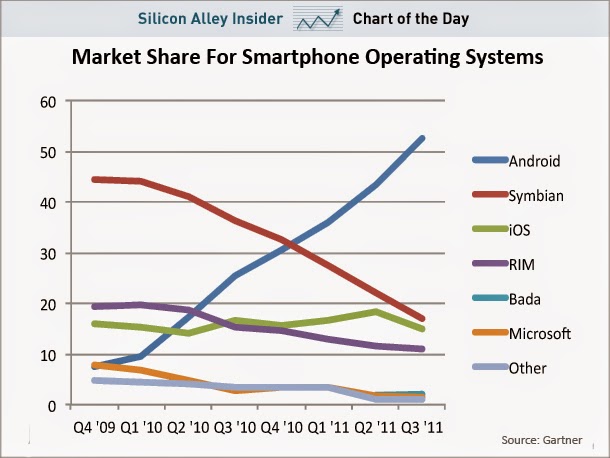
Android: Android began in 2003 as a secret project to make digital cameras and cellphones smarter.  In 2005, it was acquired by Google and became the foundation for their mobile Operating System (OS).  In 2007, Google launched the Open Handset Alliance which is a consortium of phone manufacturers, cellular carriers, chipset manufacturers.  These companies mutually agreed not to sue each other for patent infringements and to refrain from developing on incomplete forks in the Android development chain.

About this same time in 2007, Apple released their first iPhone.  Apple chose not to be a part of the consortium, but to compete against Android using patents and Intellectual Property rights to protect their innovations (many of which were taken from the Android).

Apple started off with a good chunk of market share, primarily due to getting a better product out to market faster.  They held on as long as they could, but in the end it was one company doing all the software and hardware development vs. the rest of the world.  The inevitable result is illustrated in the graph below as well as in this story in Business Insider.


There are plenty of other examples where Fully-Distributed Networks are making the big monopolies, oligopolies obsolete.  The most notable is how email has just about completely destroyed the U.S. Postal Service, which only remains in business due to taxpayer subsidies and the fact that it is against the law for other companies to deliver mail.

There is no doubt that the Internet is at the core of many of these new disruptive technologies.  While most of us can only access the Internet through an Internet Service Provider (ISP) which is a highly regulated entity, this may not always be the case.  For the wireless Internet, many of use our cellphones and/or tablets which are connected to the Internet through a cellphone company like Verizon, Sprint, Vodaphone, AT&T or T-Mobile.

Now there is apparently a device coming to market this winter which will allow you to bypass your cellular company and communicate using, text, voice, using your own miniature "cell towers".  Check out the GoTenna.    The concept looks like it could present a new future in wireless communications.  While the first generation has a limited range, there is no reason that these devices cannot be networked to send data further, much like the early days of Computer Bulletin Board Systems (BBS) did by hopping data across multiple nodes to get from point A to point B.

There is also no reason to assume that people won't figure out how to use them for repeaters, to extend their ranges all over the world - all without paying for any service whatsoever - free peer-to-peer communications with no ISP, no Cell Phone company.  It could totally take place outside of the Internet as well, offering more privacy from the NSA snoops.

What do you think?

What other industries could use some Disruptive Technologies?


Feel free to throw some answers out in the Comments section...


Sunday, July 27, 2014

How to get Bitcoin

 Different ways to get Bitcoin:


People who are new to using Bitcoin may be wondering, "how do I start getting some coin?"

Just as with conventional money, there are three basic ways to get it.  

  1. Earn it:  While most employers are not offering to pay their employees in Bitcoin, there are a few.  You can find them if you look for them on Google.  Most of these jobs are going to involve programming, software development, and the like; however there are a lot of blogs and niche websites out there looking for freelance writers and graphic artists who are willing to pay with the currency.  You can sell stuff online using Square and easily accept Bitcoin, or make your own website and place "Pay with Bitcoin" buttons linked to your Coinbase account 
  2. Buy it:  You can trade any other currency for Bitcoin on an exchange or in person.  To buy Bitcoins on an exchange in the U.S., I like to use Coinbase.  Buying in person is more private, since exchanges are regulated by governments and will eventually no longer be private.  To find local people to buy privately, I like to use LocalBitcoins.  A lot of people trade coins.  I've met a few that just buy coins on Coinbase, then sell them on LocalBitcoins with a small mark-up  
  3. Mining:  Bicoins are put into circulation through a process called "mining".  Mining is very
    similar to mining gold or silver.  There is a finite amount of Bitcoins possible (21 million total can be mined).  Currently there are about 13.1 million coins in circulation.  A Bitcoin miner is a special computer system that acts as an anonymous node on the network processing the transactions by writing them into the Blockchain (the public ledger of all Bitcoin transactions).  All miners around the world agree on the order of transactions placed in the ledger, and the order of transactions determines who owns what.  In the midst of this process, miners are also generating the cryptographic hashes needing to encode the blocks and secure the Blockchain.  Miners are rewarded for each successful block by receiving 25 newly-minted coins.  Today, mining has become so difficult that pools of miners typically hash together and divide the coins according to shares of work completed.  Successful mining requires a financial commitment, and continual upgrading of equipment to stay on top of the increases in difficulty.  


There are a lot of other creative things you can do to earn Bitcoins, feel free to leave your suggestions in the comments section.

If you learned something, benefited from this article, or just enjoyed it, feel free to leave a tip:

1EMB2RUaaKzWMUEHQ7zWBFkxmxju2Nkzpj