Michael Mogren, a local Denver entrepreneur, stopped by Liberty on the Rocks Denver to discuss why Intellectual Property (IP) shouldn't be considered actual property.
Showing posts with label Capitalism. Show all posts
Showing posts with label Capitalism. Show all posts
Saturday, February 14, 2015

Monday, September 8, 2014
Samsung Ready to Sue Apple Over iPhone 6
 As the world awaits the unveiling of Apple's iPhone 6 which is set to launch on September 9th, trouble is already brewing between Apple and their arch-rivals Samsung. Rumors are that Apple will announce two versions of the iPhone 6, one with a 4.7-inch screen and one with a 5.5-inch screen.
Apple, which has historically protected its designs using patents (most-notably the patent for rounded
corners) now embarrassingly finds itself at the business end of a lawsuit for patent infringement after Samsung announced that they plan to sue for Apple's blatant infringement on their patent of 5.5 inches.
After losing a 1 billion dollar lawsuit for infringing on Apple's patents, Samsung seeks to recover their losses by going after Apple for infringing on their 5.5 inch design that was used on their highly-successful Galaxy Note II "Phablet".
 |
| Apple's Tim Cook responded to Samsung's threats to sue by suggesting that Samsung's flippant use of the letter 'i' has caused Apple irreparable damages. |
Wednesday, September 3, 2014
World's First Decentralized, Encrypted Market - The Untouchable Black Market is Almost Here


The Silk Road represented total freedom in the marketplace - the freedom to buy or sell anything you want, without the need to report your activities to anyone, no tax returns, no government regulations, it was totally anonymous. But it's weakness was centralization. A single point of failure took it all down, that was the computers owned by the DPR.
The day after the raid someone else created The Silk Road 2.0, but after a short while, it got hacked and $2.7 million worth of Bitcoins were stolen. Again, the weakness was a single point of failure caused by centralization.
Centralization is what allows government to control and regulate business and entire industries. To control the cell phone industry, you only need to regulate the cellular network providers of which there aren't very many, and each one operates using centralized networks.
Along came Decentralized Networks or Fully-Distributed Networks. These are networks that operate

Now comes OpenBazaar.org, the world's first decentralized, fully-distributed free market, where anyone can buy or sell anonymously and there are no single points of failure. It is censor-proof, oblivious to governmental borders, and cannot be regulated, censored, or controlled by any government. It can never be seized, shut down, or stopped in any way.
The site promises to be much like Amazon and eBay, where sellers and buyers can rate each other and write reviews so people can see who the trustworthy buyers and sellers are. We are definitely looking forward to the launch of some much-needed freedom in the economy
Read more:
Openbazaar the Untouchable Online Market Inches Closer to Game Time
Openbazaar.org
Monday, September 1, 2014
Fully-Distributed Disruptive Technologies Set to Break Up Big Conglomerates and Monopolies
The key to government control of an industry sector is regulation of large corporations that are the backbone of that industry. For example, you buy electricity from a local provider. That provider is a regional monopoly that is highly regulated by the government. The monopoly enjoys a guaranteed profit without any risk. Large companies love government regulation because it socializes their risks and they earn guaranteed profits. This rent-seeking behavior is the driving force of monopolization.
 Local electricity providers name their price, and you have no choice but to pay it, for this reason monopolistic businesses are called Price Setters.
In free markets, businesses must sell for what the market is willing to pay since there are many competitors vying for the sale, for this reason businesses operating in a free market are called Price Takers. Free markets are the exact opposite of a monopoly. Free and unregulated markets have not really existed in this country for quite a long time (think centuries), but now with the advent of Fully-Distributed Networks, we are starting to see them return and there is nothing the government can do to stop it.
Using our electrical monopoly example... the monopoly enterprise must generate the power, then distribute it to their customers many of whom are located many miles away. Transmitting electricity over long distances like this creates losses due to the inefficiency (impedance in transmission lines). The consumer must pay for these inefficiencies as well as tolerate any regulations that are placed on them in order to guarantee the profits to the utility company. Those regulations are getting more and more intrusive with lightbulb restrictions, the increased usage of Smartmeters, remote air conditioner cycling, etc.
Now imagine that you had a device in your backyard (and/or on your roof) that produced all the
 |
| The DFC300 Fuel Cell pictured here can provide power to 250 homes |
Microgrids are another type of disruptive technology that is on the rise throughout the world. These usually incorporate a power plant that can power a small neighborhood, office building, or residential development. Several companies can operate small electrical utility networks that compete against each other.
Larger fuel cells or solar/wind stations can be used for whole neighborhoods. Imagine if you had the option to buy power from one of several providers or your Home Owners Association. That freedom of choice in providers that the consumer enjoys forces those utility companies to compete by lowering prices and improving service.

Open Source Development is another example. Historically, inventors and manufactures sought protection of their ideas from competition in the market through the obtaining of a patent by the government. The patent grants the inventor a temporary monopoly on their invention for a period of time. Other companies are not allowed to infringe on the invention without a licensing agreement which usually involves paying a licensing fee plus royalties.
Companies will spend billions of dollars protecting their patents by suing other companies and small inventors for patent infringement. This behavior wastes resources that could be spent on innovating and improving their existing designs, and also discourages others from making improvements to existing inventions. Many small inventors are put off by the expense of needing to hire a lawyer to do a patent search before proceeding with their invention, so they are defeated before they even begin.
So, along comes Open-Source Development. Open-Source Development is a development strategy that does not seek patents, copyrights, or other intellectual property protections. In fact it encourages competitors to co-develop a product by providing all blueprints, schematics, design documents, software code, etc. to the public free of charge. Companies that use this development strategy have seen massive increases in the speed of product improvement, growth in sales, and a massive decrease in legal expenses in trying to protect their invention. Some examples of this strategy and their effects on the competition are listed here:

Encyclopedia Britannica, which was once the largest seller and publisher of encyclopedias ceased publishing their famed books in 2010 after dominating the market for over 240 years.
 3D Printing: Imagine if everybody owned a manufacturing facility that was simple to operate - as
easy as printing out a document on your computer... That is the future of personal manufacturing through 3D Printing which allows you to print physical objects with plastic or metal. 3D printing is not a new technology - it's been around about 30 years, but it has recently become much more affordable thanks to Open Source Development.

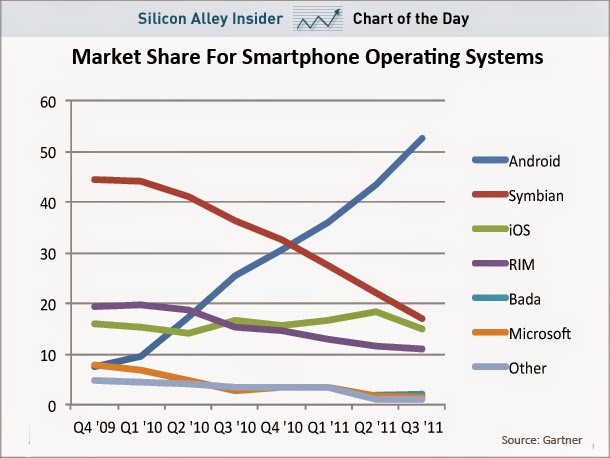
About this same time in 2007, Apple released their first iPhone. Apple chose not to be a part of the consortium, but to compete against Android using patents and Intellectual Property rights to protect their innovations (many of which were taken from the Android).
Apple started off with a good chunk of market share, primarily due to getting a better product out to market faster. They held on as long as they could, but in the end it was one company doing all the software and hardware development vs. the rest of the world. The inevitable result is illustrated in the graph below as well as in this story in Business Insider.
There are plenty of other examples where Fully-Distributed Networks are making the big monopolies, oligopolies obsolete. The most notable is how email has just about completely destroyed the U.S. Postal Service, which only remains in business due to taxpayer subsidies and the fact that it is against the law for other companies to deliver mail.
There is no doubt that the Internet is at the core of many of these new disruptive technologies. While most of us can only access the Internet through an Internet Service Provider (ISP) which is a highly regulated entity, this may not always be the case. For the wireless Internet, many of use our cellphones and/or tablets which are connected to the Internet through a cellphone company like Verizon, Sprint, Vodaphone, AT&T or T-Mobile.

There is also no reason to assume that people won't figure out how to use them for repeaters, to extend their ranges all over the world - all without paying for any service whatsoever - free peer-to-peer communications with no ISP, no Cell Phone company. It could totally take place outside of the Internet as well, offering more privacy from the NSA snoops.
What do you think?
What other industries could use some Disruptive Technologies?
Feel free to throw some answers out in the Comments section...
Thursday, August 28, 2014
Liberation Through Fully-Distributed Networks: Part 2 - 3D Printing
Part 2: 3D Printing as a Fully-Distributed Manufacturing Network.
How Fully-Distributed Networks like Bitcoin and 3D Printing will liberate everyone from the tyranny of monopolies and government.

Liberation through Fully-Distributed Networks: Part 1 - Monopolies
How Fully-Distributed Networks like Bitcoin and 3D Printing will liberate everyone from the tyranny of monopolies and government.
Sunday, July 27, 2014
How to get Bitcoin
 Different ways to get Bitcoin:
People who are new to using Bitcoin may be wondering, "how do I start getting some coin?"
Just as with conventional money, there are three basic ways to get it.
- Earn it: While most employers are not offering to pay their employees in Bitcoin, there are a few. You can find them if you look for them on Google. Most of these jobs are going to involve programming, software development, and the like; however there are a lot of blogs and niche websites out there looking for freelance writers and graphic artists who are willing to pay with the currency. You can sell stuff online using Square and easily accept Bitcoin, or make your own website and place "Pay with Bitcoin" buttons linked to your Coinbase account
- Buy it: You can trade any other currency for Bitcoin on an exchange or in person. To buy Bitcoins on an exchange in the U.S., I like to use Coinbase. Buying in person is more private, since exchanges are regulated by governments and will eventually no longer be private. To find local people to buy privately, I like to use LocalBitcoins. A lot of people trade coins. I've met a few that just buy coins on Coinbase, then sell them on LocalBitcoins with a small mark-up
- Mining: Bicoins are put into circulation through a process called "mining". Mining is very similar to mining gold or silver. There is a finite amount of Bitcoins possible (21 million total can be mined). Currently there are about 13.1 million coins in circulation. A Bitcoin miner is a special computer system that acts as an anonymous node on the network processing the transactions by writing them into the Blockchain (the public ledger of all Bitcoin transactions). All miners around the world agree on the order of transactions placed in the ledger, and the order of transactions determines who owns what. In the midst of this process, miners are also generating the cryptographic hashes needing to encode the blocks and secure the Blockchain. Miners are rewarded for each successful block by receiving 25 newly-minted coins. Today, mining has become so difficult that pools of miners typically hash together and divide the coins according to shares of work completed. Successful mining requires a financial commitment, and continual upgrading of equipment to stay on top of the increases in difficulty.

There are a lot of other creative things you can do to earn Bitcoins, feel free to leave your suggestions in the comments section.
If you learned something, benefited from this article, or just enjoyed it, feel free to leave a tip:

Saturday, July 26, 2014
How to get started with Bitcoin

A lot of people are put off by the high price of Bitcoins (currently about $460 US per coin). When Bitcoin first launched a few short years ago, they sold for $0.001 per coin and have traded around $1,200 at their peak in 2013. Fortunately, Bitcoins are divisible into parts just like any other type of money. Bitcoins can be broken down into 100,000,000 parts. The smallest part (1 hundred millionth) of a Bitcoin is often referred to as a "Satoshi". So, there is no need to worry about investing a lot of money. Go ahead and buy $100 worth or if that's too risky try $5 worth. There really isn't a minimum amount that you must purchase, though once you get down to the hundred thousanths or millionths place, you'll start to incur some errors due to volatility and rounding on the fiat side of the equation (sometimes referred to as Satoshi Spam).
Here is how you can get started in a two simple steps:
1. Get a free Bitcoin WalletA wallet is a piece of software where you can receive Bitcoins and from which you can send them. It contains a private encryption key, that is contained within the software. Your wallet addresses are public encryption keys which you can safely give out to anyone in order to receive money from them. When someone sends money, they basically send an encrypted message which state the amount of Bitcoins being sent. That message is encrypted using the public key of the recipient. Since the public key matches the private key contained in the recipients wallet, only the recipient can interpret the message and receive the coins.
There are several wallet options. You can download a local wallet which will be stored on your device (desktop, laptop, phone, tablet, etc.) You must be careful to back up these wallets (by simply printing out your wallet addresses) in case you lose your device or your hard drive crashes.
To download a good offline wallet, go to: https://blockchain.info/wallet
A hosted wallet is online and can be accessed from any computer through the web. A good password is needed in order to keep it secure so others can't log into your account. I also recommend signing up for 2-step authentication which is offered by most online wallets. Instructions for doing this are provided on those sites.
I like Coinbase for their online wallet because they are also a Bitcoin exchange, so you can load your wallet from a connected bank account if you wish.
To get started with Coinbase, click the link below and follow the on-screen instructions.

You can also download wallet software to your mobile devices on Android and now on iPhone as well. Keep in mind that Bitcoins kept in those wallets will be lost if you lose your device (or it breaks) if you do not back them up (print or screencap wallet addresses.
2. Buy your first Bitcoin
If you're set up with Coinbase and have a connected bank account you can purchase coins directly from their exchange into your wallet. You first purchase will take up to ten days to process. Coinbase may collect a very small fee for the service.
You can also buy them directly from regular people online or in person. To find people in your area to trade coins with, open up a free account at www.LocalBitcoins.com. This allows you to buy Bitcoins and meet new people at the same time. It also allows you to pay cash for Bitcoins. Transactions are listed on the website, and users can rate each other. The website also allows you to buy/sell online rather than in person and includes an escrow service so you can avoid getting ripped off.
Benefits of Bitcoin
- No banks
- No bank fees
- Transactions happen very quickly (usually 10 minutes or less)
- Transactions are encrypted and secure
- You can be as anonymous as you wish
- All transactions are public record and can be viewed by anyone
- It is a deflationary currency, rather than an inflationary one (it appreciates in value over time).
- Currency cannot be controlled by any central bank or government. Minting of coins is done in a steady and predictable manner with a finite maximum number of coins (21 million Bitcoins total which will all be in circulation in the year 2140).
Drawbacks of Bitcoin
- Takes a little time to learn and get the hang of, but once you do it turns out to be fun.
- Once money is sent, there is no getting it back. No ability to cancel a payment already made or do a "chargeback" as with credit cards.
- Online/hosted wallets are only as secure as your username and password (as with online banking)... USE 2-STEP VERIFICATION!
- Price volatility - This is due to a relatively tiny market capitalization in relation to central bank currencies, but it's getting more stable over time.
If you found this article helpful, feel free to leave a tip: 1Mq2mDWt2dKFQsqCnizkaXpPxwkUMfkRNH
Sunday, July 13, 2014
Why "Capitalism" Fails and how Bitcoin saves it
Many of the critics of capitalism love to point to those parts of the world where newly-freed markets have encountered major problems as "proof" that capitalism doesn't work.
Without hesitation, big-government advocates will talk about large global corporations that were deemed "too big to fail", and had to be bailed out at the expense of the taxpayers and little guys. With similar logic, they point to former Soviet bloc countries which have seen violent opposition to capitalist reforms and little benefit from them.
Like many controversies, much of the problem lies in the differing definitions of words. To a Free-Market Capitalism, free market means zero regulation. To pro-government socialists, "free market" usually means "not regulated the right way" or "not regulated enough".
The truth is that the big banks, auto manufacturers, and investment firms that received the bailouts from the U.S. government operate in the some of the most highly-regulated industries on earth.
For example, the auto industry is regulated by thousands and thousands of laws and regulations; everything from those pertaining to import/export restrictions, safety, fuel economy to labor relations, and emissions standards - not to mention the SEC regulations controlling the issuing and sales of company stocks and their financial businesses like GMAC. Each of these regulations presents a barrier of entry to new players in the market. This is how government protects the cartel, by discouraging competitors from entering and competing against their existing political contributors and allies. This stifles innovation.

Then there are those who bring up the failure of "free markets" in other countries. There is a very long list of countries which were once socialist or communist, but then either peaceably or through violent revolt gained some level of personal and/or economic freedom, only to find that the transition didn't go as smoothly as free market advocates had hoped for.
Hernando deSoto makes a great observation in his book The Mystery of Capital where he explains the foundation of all capital in being the establishment of undisputed claims to property. The thing that makes capitalism work is that the foundation of all capitalism lies in proving that a particular piece of property actually belongs to a particular person or entity.
He also argues that capitalism has been successful in the west precisely because of the establishment of records of ownership via titles. In the west, when a person purchases a piece of property, there is a record of the transfer of ownership that is recorded in a public registry which can be accessed by anyone.
Still, accusations of collusion, forgery, corruption, and conspiracy would occasionally bring challenges
 to this system, which would be resolved by a system of courts. In countries where distrust of government institutions, courts, and wealthy landowners is embedded in the minds of the populace (such as in former communist countries), this system is even more limited. Trust in the institutions that witness and record these transactions is absolutely necessary for the entire system to function. That trust often does not exist in other countries and cultures.
What made the limited form of capitalism that the U.S. enjoyed a success was the system of public record-keeping of property ownership that was somewhat accurate and the court system that was in place for resolving disputes. When buying a house, for example, a lawyer or title company could do a simple search through public records to find if the seller has the legitimate legal right to sell the house to the buyer and transfer that ownership and file the transfer with the local government office in order to list it in the public record.
Today, we are seeing a very strong erosion of that trust in the system which is needed in order to facilitate the peaceful exchange of goods due to the exposure of the corruption that is (and probably has been) in the system. The massive amounts of foreclosures going on with the current and on-going housing crisis is exposing the fact that many people are being defrauded out of their homes through either corrupt lawyers, banks, and title companies, environmental regulations, and/or through lazy and sloppy filings.
The failure of these centralized systems is that they require a level of trust in the system.
Enter the Blockchain
The backbone of the phenomenon that is crypto-currency, the most famous of which is Bitcoin, is the Blockchain. The Blockchain is a public record of ownership of currency which is anonymous, fully-distributed, decentralized, and publicly viewable from any computer. The computer code behind the Blockchain is open-source so anyone can view it to make sure it is on the up and up.
Bitcoin transactions work by simply updating records in this public ledger which is stored on multiple computers all over the world, and agreed upon by all of them. The entry of transactions appear in the order decided by the network itself and not by any person or group of persons. For every transaction the ownership of the coins being used as currency is traced all they way back through the Blockchain to the time the coins first went into circulation or all the way back to the Genesis Block. Best of all, the entire thing is encrypted, secure, and anonymous. While this system is what is used for the transfer of currency, the uses for the Blockchain idea are nearly endless.
The beauty of the Blockchain system is that it requires zero trust in anyone. In fact, it operates on the assumption that everyone is a crook.
Here are some of the other potential uses for blockchains:
Title transfers of real estate. The use of a blockchain for real estate is the next most-logical step. This would eliminate the need for lawyers and title companies along with their outrageous fees.
The existence of a public ledger that is free from political corruption would work miracles in places where land disputes often escalate into violent wars. This is one of the primary roles for many or perhaps most country governments, almost eliminating the need for a county government altogether.
 Sales of automobiles. Imagine no more involvement of the local or state DMV in selling or buying
cars. No more standing in their lines, paying whatever fees they demand, and no more annual registration fees.
The need for license plates also goes away - which won't make law-enforcement happy, but it's your right not to be identified while traveling, and you've given up that right by putting a license plate on your car.
 Ownership and Structure of Corporations. Already, the blockchain model is being to theoretically create corporations where the ownership is fully-distributed and shares are traded like currency on a Blockchain instead of on a central trading floor through
a brokerage.
Intellectual Property Rights. While most advocates of decentralized networks are opposed to the idea of Intellectual Property in general, there is no reason that a Blockchain could not be used for this purpose. This would eliminate the central bureaucratic powers that run the U.S. Patent and Trademark Office and their foreign counterparts. Enforcement of these "rights" would be a different subject altogether, though a voluntary system could be implemented and the Blockchain could be used for the management of royalty payments and licensing fees, etc.
 Registration of Internet Domain Names. Currently Domain Names are registered by a single corporation that holds a monopoly on this service (ICANN). The oversight of a world-wide distributed network like the Internet by a corporate monopoly makes little sense. Complaints against ICANN abound, and they are often slowly and poorly handled (as you would expect from a monopoly). Replacing ICANN with a group of fully-distributed networks could handle all their functions and totally replace the organization.
Namecoin is already in the process of making much of this happen.
Much of the "under the hood' stuff of the World Wide Web systems could be better managed by distributing these tasks through the network of a blockchain. A lot of the stuff most of us never see like the management of TLS/SSL certificates and that sort of thing.
The reason capitalism has failed to take hold or flourish in many 3rd world countries is taken away by the Blockchain. A trustworty, anonmymous, private, encrypted, secure, and efficient system that records ownership records is here. It will liberate the entire world by crushing cartels like the Federal Reserve, the International Monetary Fund, the World Bank, OPEC, the New York Stock Exchange, the regional energy utilities, Internet Service Providers, currency exchanges (FOREX), NASDAQ, as well as the drug cartels, not by outright destruction, but by making them irrelevant and obsolete. Bitcoin can and will liberate the world... peacefully.
This is just the beginning.
Subscribe to:
Posts (Atom)