A-Ads

Showing posts with label Economics. Show all posts

Thursday, February 19, 2015

Andreas Antonopoulous explains how Bitcoin works at M.I.T.


Andreas Antonopoulous never disappoints.  

Here he explains the functioning of Bitcoin and its advantages over other forms of money in a way that is easy to understand for the beginner, yet educational for non-beginners also.  


Thursday, September 25, 2014

Bitcoin's Biggest Hater, Peter Schiff, Now Accepting Bitcoin. The Rise of Darkcoin


Peter Schiff, son of the imprisoned author/tax protestor Irwin Schiff, has been a very vocal critic of Bitcoin.  He has appeared in many debates with Bitcoin evangelists.  He has always been a strong advocate of hard assets, specifically precious metals over crypto-currencies.

His company which sells gold and silver just began accepting Bitcoin, though he claims he still doesn't believe in it.  

In this video, Max Keiser has some fun calling out Peter Schiff on his stance then goes on to discuss the importance of Darkcoin and interviews one of the developers of Dark Wallet.  

 This is well worth watching in its entirety.


Monday, September 1, 2014

Fully-Distributed Disruptive Technologies Set to Break Up Big Conglomerates and Monopolies


The key to government control of an industry sector is regulation of large corporations that are the backbone of that industry.  For example, you buy electricity from a local provider.  That provider is a regional monopoly that is highly regulated by the government.  The monopoly enjoys a guaranteed profit without any risk.  Large companies love government regulation because it socializes their risks and they earn guaranteed profits.  This rent-seeking behavior is the driving force of monopolization.

Local electricity providers name their price, and you have no choice but to pay it, for this reason monopolistic businesses are called Price Setters.

In free markets, businesses must sell for what the market is willing to pay since there are many competitors vying for the sale, for this reason businesses operating in a free market are called Price Takers.  Free markets are the exact opposite of a monopoly.  Free and unregulated markets have not really existed in this country for quite a long time (think centuries), but now with the advent of Fully-Distributed Networks, we are starting to see them return and there is nothing the government can do to stop it.

Using our electrical monopoly example...  the monopoly enterprise must generate the power, then distribute it to their customers many of whom are located many miles away.  Transmitting electricity over long distances like this creates losses due to the inefficiency (impedance in transmission lines).  The consumer must pay for these inefficiencies as well as tolerate any regulations that are placed on them in order to guarantee the profits to the utility company.  Those regulations are getting more and more intrusive with lightbulb restrictions, the increased usage of Smartmeters, remote air conditioner cycling, etc.

Now imagine that you had a device in your backyard (and/or on your roof) that produced all the
The DFC300 Fuel Cell pictured here can provide power to 250 homes
electricity you needed, perhaps a combination of fuel cell, solar, and wind technologies.  There would be virtually no transmission losses since the distance to your house is very short.  You have just become a threat to the local monopoly.  Now imagine that everyone had them.  The monopoly would cease to exist despite their guarantee of profit from the government.  This form of peaceful rebellion is spreading through many industries, and for this reason, Fully-Distributed Networks are often referred to as "Disruptive Technologies".

Microgrids are another type of disruptive technology that is on the rise throughout the world.  These usually incorporate a power plant that can power a small neighborhood, office building, or residential development.  Several companies can operate small electrical utility networks that compete against each other.

Larger fuel cells or solar/wind stations can be used for whole neighborhoods.  Imagine if you had the option to buy power from one of several providers or your Home Owners Association.  That freedom of choice in providers that the consumer enjoys forces those utility companies to compete by lowering prices and improving service.


Bitcoin is one of the biggest currently growing and spreading throughout the world and it seeks to destroy or disrupt national and world banking cartels such as the Federal Reserve Bank and International Monetary Fund.


Open Source Development is another example.  Historically, inventors and manufactures sought protection of their ideas from competition in the market through the obtaining of a patent by the government.  The patent grants the inventor a temporary monopoly on their invention for a period of time.  Other companies are not allowed to infringe on the invention without a licensing agreement which usually involves paying a licensing fee plus royalties.

Companies will spend billions of dollars protecting their patents by suing other companies and small inventors for patent infringement.  This behavior wastes resources that could be spent on innovating and improving their existing designs, and also discourages others from making improvements to existing inventions.  Many small inventors are put off by the expense of needing to hire a lawyer to do a patent search before proceeding with their invention, so they are defeated before they even begin.

So, along comes Open-Source Development.  Open-Source Development is a development strategy that does not seek patents, copyrights, or other intellectual property protections.  In fact it encourages competitors to co-develop a product by providing all blueprints, schematics, design documents, software code, etc. to the public free of charge.  Companies that use this development strategy have seen massive increases in the speed of  product improvement, growth in sales, and a massive decrease in legal expenses in trying to protect their invention.  Some examples of this strategy and their effects on the competition are listed here:

Wikipedia:  Anyone can create an entry or edit an existing entry on the online encyclopedia Wikipedia which currently boasts over 32 million articles in 287 languages.  This is over 100 times the volume of the Encyclopedia Britannica.

Encyclopedia Britannica, which was once the largest seller and publisher of encyclopedias ceased publishing their famed books in 2010 after dominating the market for over 240 years.


3D Printing:  Imagine if everybody owned a manufacturing facility that was simple to operate - as
easy as printing out a document on your computer...  That is the future of personal manufacturing through 3D Printing which allows you to print physical objects with plastic or metal.  3D printing is not a new technology - it's been around about 30 years, but it has recently become much more affordable thanks to Open Source Development.


Android: Android began in 2003 as a secret project to make digital cameras and cellphones smarter.  In 2005, it was acquired by Google and became the foundation for their mobile Operating System (OS).  In 2007, Google launched the Open Handset Alliance which is a consortium of phone manufacturers, cellular carriers, chipset manufacturers.  These companies mutually agreed not to sue each other for patent infringements and to refrain from developing on incomplete forks in the Android development chain.

About this same time in 2007, Apple released their first iPhone.  Apple chose not to be a part of the consortium, but to compete against Android using patents and Intellectual Property rights to protect their innovations (many of which were taken from the Android).

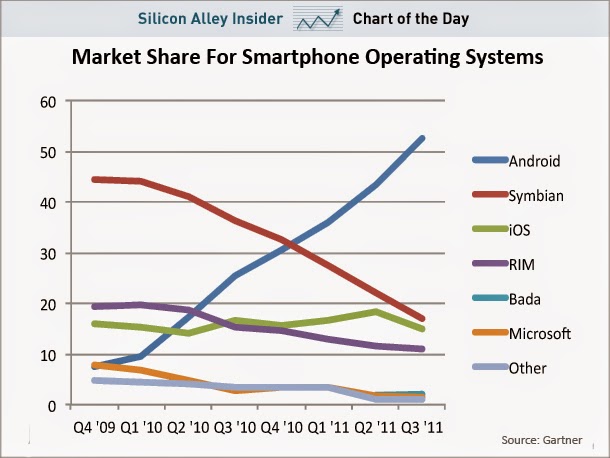
Apple started off with a good chunk of market share, primarily due to getting a better product out to market faster.  They held on as long as they could, but in the end it was one company doing all the software and hardware development vs. the rest of the world.  The inevitable result is illustrated in the graph below as well as in this story in Business Insider.


There are plenty of other examples where Fully-Distributed Networks are making the big monopolies, oligopolies obsolete.  The most notable is how email has just about completely destroyed the U.S. Postal Service, which only remains in business due to taxpayer subsidies and the fact that it is against the law for other companies to deliver mail.

There is no doubt that the Internet is at the core of many of these new disruptive technologies.  While most of us can only access the Internet through an Internet Service Provider (ISP) which is a highly regulated entity, this may not always be the case.  For the wireless Internet, many of use our cellphones and/or tablets which are connected to the Internet through a cellphone company like Verizon, Sprint, Vodaphone, AT&T or T-Mobile.

Now there is apparently a device coming to market this winter which will allow you to bypass your cellular company and communicate using, text, voice, using your own miniature "cell towers".  Check out the GoTenna.    The concept looks like it could present a new future in wireless communications.  While the first generation has a limited range, there is no reason that these devices cannot be networked to send data further, much like the early days of Computer Bulletin Board Systems (BBS) did by hopping data across multiple nodes to get from point A to point B.

There is also no reason to assume that people won't figure out how to use them for repeaters, to extend their ranges all over the world - all without paying for any service whatsoever - free peer-to-peer communications with no ISP, no Cell Phone company.  It could totally take place outside of the Internet as well, offering more privacy from the NSA snoops.

What do you think?

What other industries could use some Disruptive Technologies?


Feel free to throw some answers out in the Comments section...


Thursday, August 28, 2014

Liberation through Fully-Distributed Networks: Part 1 - Monopolies


How Fully-Distributed Networks like Bitcoin and 3D Printing will liberate everyone from the tyranny of monopolies and government.


Tuesday, July 29, 2014

Apple vs. Bitcoin

Apple is finally and reluctantly getting on board with Bitcoin and this clearly illustrates how their outmoded way of thinking is killing them.
After banning and removing all Bitcoin related apps from their Appstore, they are now slowly starting to allow a few of the big ones on-board.

Unlike Android, Apple has complete control of what is allowed to be sold in their Appstore.  They decide what apps you're allowed to purchase and what you cannot.  They have also fought efforts to jailbreak their phones or sideload apps from sources other than the Appstore.

Why is Apple opposed to innovation?
Apple claims that their reason for pulling Bitcoin-related apps was due to the Silk Road bust.  Silk Road was a pirate website, that provided a market for all sorts of illicit products and services that could be bought with Bitcoin - everything from music, movies, and games to drugs, hookers, and hitmen could be purchased anonymously using Bitcoin.  The alleged operator of The Silk Road, the Dread Pirate Roberts, was arrested in 2013 and his home raided.  Feds seized computers with coin wallets containing over 30,000 BTC.

But, Bitcoin is not the only currency used to commit these so-called crimes.  While 30,000 BTC is a sizable amount of money, it pales in comparison to many other busts involving credit card fraud, drugs, etc. in which the criminals used Dollars, Euros, Pesos, or Rupees - yet no bans on apps that use these currencies or credit cards were even considered.

The Bitcoin architecture is a fully-distributed network.  It is based on the exact opposite of this Command and Control mentality, which is probably why it frightens the folks at Apple.  Apple has always been about design over innovation.  When they carried the largest share of the Smartphone market they acted like tyrants - dictating what people can and can't do with their devices.  Those days are gone, and Apple's market share is average, though they still act like they control the market.

By using open-source code and a totally free market, Android has completely surpassed Apple leaving
them far behind.  Android's market share for the 1st quarter of 2014 checked in at over 81% and it's still growing, while Apples IOS has been stagnant and trending slightly downwards.  Apple IOS checked in at 15.2% for the 1st quarter of 2014, down from 17.1% in the same quarter the previous year.

What makes Android so much better than IOS?  Both operating systems are very powerful.  Some would argue that they are almost equal utility, yet Android completely dominates in sales.

The difference is that Android is not centrally controlled.  It is an open-source and provides a free market for app developers.  Android vs. IOS is basically Free-Market Capitalism vs. Command and Control Socialism.

Bitcoin is a system of Free-Market Capitalism for money that is independent from central banks and government.  If we were to draw a graph of Bitcoin vs. U.S. Dollars (or any other government-sanctioned, central-bank currency) it would look like the Android vs. IOS graph above- although we are only at the very beginning.

As Bitcoin continues to gain momentum, the government currencies will become more and more irrelevant.

Related Reading:  
Forbes: Why Apple is Afraid of Bitcoin
Digital Trends: Bitcoin Users Smash Their iPhones after Apple Bans Last Bitcoin Wallet From Appstore
Apple Warms Up To Bitcoin with Reintroduction of Blockchain on Appstore


Wednesday, June 4, 2014

Death of the Six Dollar Burger


In 2001, the California-based fast-food chain, Carl's Jr introduced their Six Dollar Burger.  This products spearheaded a marketing campaign whose idea was to make a direct comparison of their fast-food burgers to some of the premium, top-of-the-line burger offerings of major restaurant chains like Chili's or Red Robin. In fact they even mentioned the burgers at some of these restaurants in their ad campaigns.  The ads poked fun at those fancier sit-down restaurants with people having trouble getting the waitress' attention, having drinks spilled on them, and having to leave tips, etc.


They proudly proclaimed that now, you can get a comparable burger for less money and no need to leave a tip.  You can get a "Six-Dollar Burger" for under $4.  At that time, a Big Mac from McDonald's sold for $2.54.

This served as a great marketing campaign however, as predicted by many people, it wouldn't be able to last because inflation would render this campaign (if not the product itself) obsolete.  It's like how the Five and Dime Stores became Dime Stores, then Dollar Stores and will soon become Five-Dollar Stores.

Today, those $6 burgers at Chili's typically sell for about $9-10 for a basic hamburger and up to $13 for a more premium cheeseburger, while the Big Mac sells for about $4.50.

Recently, the price of many of Carl's Jr. Six Dollar burger options were priced at $6 or above.  The idea of a burger costing $6 isn't seen by the public as premium fare anymore, it more-likely tends to conjure up images of the happy-hour burger special at the local dive bar.

Still the Six Dollar Burger campaign got a longer run than I thought it would.  In my opinion, it should have ended years ago.  The name given to the Hardee's version, which was always known as the Thickburger, has replaced the Six Dollar Burger.  (Though it is a gradual phase-out with the current brand being the "Six Dollar Thickburger").

The problem with the campaign was never with the burger, it was always a very good burger.  The increase in price was not due to improvements in its quality, added value, or anything of that sort, it was strictly due to the devaluing of the U.S. dollar through inflation.

In 2010, a Six Dollar Burger with fries would very likely cost you more than $6, while the fries at those fancier sit-down restaurants they poked fun at would likely be included with the hamburger at no extra charge.

In order to illustrate the difference between price and value, let's look at this in terms of Bitcoin.  Let's pretend that in June of 2010, Carl's Jr re-branded their Six Dollar Burger as the 75 Bitcoin Burger - that's $6 in Bitcoin at that time.  Today, they would have had to rename it to the 0.009 Bitcoin Burger.  That's a 99.988% drop in price, simply because we're using a different currency.

Some will argue that this comparison isn't fair because the price of Bitcoin is going up.  However, the value of the burger remains constant in either case.  The loss in purchasing power that is experienced by using dollars is a function of the devaluing of the currency, not an increase in the value of the product being purchased.  Conversely, the price drop in the burger against Bitcoin is due to the increasing purchasing power of Bitcoin.  It also illustrates the decreasing value of the dollar against Bitcoin.  As of this writing, there are 645 dollars to 1 Bitcoin.

As Bitcoin continues to go up against not only the U.S. Dollar, but every other Central Bank currency on earth, more and more people are starting to take notice and get out of losing currencies and into a winning one.  The main reasons people haven't done so yet are: (a) because they do not know how to begin and (b) not enough people accept Bitcoin as a form of payment.

To get started, the first thing you'll need is a wallet.  You can get a free one from Coinbase, which I like because it's hosted online so you can access it from anywhere on any internet device.  They also make it easy to buy Bitcoins using any other currency.  Coinbase is also the preferred payment processor for some of the largest merchants that accept Bitcoin such as Overstock.com and Dish Network.
Click to get your free Bitcoin wallet.
Every day, more and more businesses are accepting Bitcoin as a form of Payment.  As more people begin using Bitcoin and asking businesses if they accept it, pressure to accept the currency increases.  Businesses that want to succeed will cater to that demand or suffer.  The price of the dollar will continue to fall, there is no saving the dollar, it is dead.

Currently the United States has military bases in 153 countries on earth (out of a total of 189-196 countries total depending on the source).  The U.S. soldiers are deployed to basically fight to keep the U.S. Petro-Dollar alive and relevant, but we are running out of countries to invade.  China and Russia have both made moves to get away from the U.S. Dollar.  Russian lawmakers are even working on instituting a ban on the American currency.  These actions, even if unsuccessful, will only devalue the dollar further.

Basic economics teaches us that inflation is caused by too many dollars chasing too few goods.  Currently, the Federal Reserve, whose sole mission is to control inflation (they like to keep it around 3% annually), has been printing cash like mad.  They call it "Quantitative Easing", and it basically means they fire up the printing presses and print money full-throttle.  They've done this three times in recent years and all that cash has been stashed in reserves, where it will do its damage at a later date when it is loaned out.  On top of this, there is a massive push for minimum wage increases.  As more companies move dollars from production to their payroll, we will find people with more dollars while less products make it to market (inflation).

Hyperinflation happens when the value of the money falls so quickly that people are pushed to spend their money now, since it will have less buying power tomorrow.  This further increases inflation creating a vicious cycle of destruction since we once again have more dollars chasing fewer products.

Hyperinflation of the U.S. Dollar is no longer just a possibility, it is an inevitability.


Thursday, May 8, 2014

What Socialism Looks Like Part 2


Click Here for Part 1

It's an election year, so the unions are out spending money in a big push for an increase in the minimum wage. Whenever unions come out of the woodwork, you invariably see the communist wings of those parties (often in the leadership positions) come out and start pushing for other communist ideas as well.

Lately the #FullCommunism hashtag has been trending on social media as more and more politicians start voicing support for a minimum wage. It's obvious that none of the people supporting this movement have ever lived under a communist regime, so here is another video illustrating what every day life was like in the Soviet Union.

This video shows various shopping experiences in Tallinn in 1990, the capital of Estonia, one year before they revolted and gained their independence from the Soviet Union.

Food was rationed in order to make sure that everyone got their "fair share".  Again, we see the quality of products and customer service when competition and the profit motive are removed from the economy.

Notice the lines for purchasing gasoline.  To those of you who think that it can not happen here, all you have to do is look to the 1970s to see that it already has happened here.  Many of us have no problem remembering the gas lines caused by rationing which was the result of the 1979 Energy Crisis that was created by the Iranian Islamic Revolution and idiotic U.S. foreign policy.


Once again, we see the effects of a top-down, command and control economy or "Planned Economy". 

In 1991, Estonia declared their independence from the USSR after a 4 year revolt known as the "Singing Revolution".  

The destruction of the centralized government, attracted investment from outside Estonia and from within.   In 2003, only 12 years after the above video, we see the effects of Capitalism in the same city of Tallinn.  


Still, we have idiots making and selling this stuff. 
Selling?  Not very Communist...


Wednesday, May 7, 2014

What Socialism Looks Like


Here is a video of a Soviet Era grocery store in Russia  from 1986.   

This striking video shows what happens when government regulates commerce.  This is the end-result of central planning and bureaucracy.  This is a prophecy of what is to come in the United States and other countries that are on the path of Socialism.  


Despite the warnings from those who lived there, the United States is steaming down the path of totalitarianism at full speed.

I grew up with a friend whose family escaped from Russia.  I remember a story he told in elementary school.  He told me about the time his father walked into a supermarket for the first time in the U.S.  He said that his father took a few steps into the door then stopped in his tracks, his jaw dropped, and just stood there and cried.

These stories are unheard by people like this:


Take a look at the video to see what society considers "fair".

Thursday, October 31, 2013

Free-Markets vs. Regulated Economies


The Magic of Self-Regulation in the Economy
We’ve all heard economists, politicians, and pundits talk about “The Market”.  Well,
what is the Market?  Put simply, the market is you and me.  It is all of us going about our business - doing what we do every day.  Whether it is going to work, buying groceries, talking on the phone, water-skiing, or just watching the TV.  Virtually every activity one can think of is a market activity.
When we are working, we are not only involved in the process of making a product or performing a service, but we are actively engaged in selling our time on the labor market to an interested buyer.  When we are using a telephone, we are buying air time at an agreed-upon price.

Price is the monetary amount at which a transaction takes place.  So, how are prices determined?  Well, in a free market price is determined to be the point at which the buyer and seller agree to make a transaction.  This is simply because if the price is too high, the buyer will not buy and if the price is too low, the seller will not sell.  This concept can be applied on an aggregate scale which often determines the “going price” of a product or service.  Competition between businesses that offer the same or similar products or services works to keep prices low and quality high, as they all try to provide the best value to the consumer for their hard-earned dollar in order to win the sale.  In this struggle to win the sale over a competitor, businesses work to give their customers the most value for the least amount of money.  Since consumers have a limited supply of money, they therefore put pressure on these competing businesses to give them the most value in exchange for their money.  
Wages work the same way.  After all a wage is nothing more than the price on the sale
of labor.  This price is set where employer (the buyer) and the employee (the seller) agree.
Supply and Demand also affect pricing.  With a given supply, price will increase or decrease in a direct relationship with demand.  Price is inversely related to supply.  With a given demand, price will decrease as supply increases and vice-versa.  
These mechanisms which are entirely voluntary, comprise a major set of forces that automatically correct any problems that may arise in the market.  For example if a shortage in materials makes it more difficult to produce a product, this shortage will automatically drive the input costs of producing the product up which will result in an increased price to the buyer.  The increase in price to the buyer will reduce the demand for the product, which will in-turn put downward pressure on the price.  The slowdown in sales will decrease the amount of materials needed, thus reducing the shortage.  
Most products have an elasticity of demand, meaning that the demand is affected by price.  Specifically, Elasticity of Demand refers to the rate of change in demand with respect to the change in price.  So, if the price of an item were to increase, the demand would taper off.  The reduced demand would then put downward pressure on the price by reducing the amount of product demanded.  The amount of elasticity in the demand of the product will determine the speed of the correction.  In other words the elasticity of demand is the amount of slope in the demand curve at a given price or the first derivative of the quantity demanded with respect to price.
The market has great power to correct negative outcomes, though this is generally in the long run.  However, for some people the problems that spring up in the market are not resolved quickly enough and want a short run solution.  These problems are referred to as “market failures”.  To these people, the solution to correct a market failure is through government intervention.  A classic example of a market failure is pollution or environmental destruction, typically associated with monopolized utilities or industrial production.  Generally speaking, the market will resolve “failures” like this assuming that there is no asymmetry in information.  Assymetry in information is when the consumer is unaware of such a problem.  When the consumers are made aware of market failures, they generally respond in a way that will offer a correction.  For example, suppose you are offered several different sources from which you could buy a certain widget.  You discover that though the products made by the different sources are similar in design, one of them is produced by a company that is polluting a river in the process.  An informed market will choose to buy from the competitor
and this will put pressure on the offending company to improve its processes in order to compete.  This could take a lot of time, especially because of the dissemination of information that is required.  This problem is more-easily overcome thanks to the internet and social media however.  But because of the time lag required for the market to respond to these sorts of issues, and the relative urgency in the need to correct these problems, many people advocate the government intervention into the market.  Government intervention can take place in several ways - (e.g. in the form of environmental regulations, price controls, taxes, tax breaks/incentives, penalties, etc).
A major problem with regulatory agencies is that they are subject to corruption by the political process, bribery, and collusion.  We are currently seeing this in the battle over Genetically Modified foods (GMOS), particularly with Monsanto.  Monsanto is the manufacturer of pesticides, herbicides, and other chemicals.  Recently, they entered the food industry and have very quickly become the world leader in producing genetically modified produce.  Through gene splicing of corn, soy, tomato, and other plant DNA with DNA from animal and e.coli bacteria, they have managed to produce crops that are resistant to higher doses of their herbicide (RoundUp).  The result is not only the increased use of these poisonous chemicals in the American food supply, but increased pollution from run-off and aerial spraying.  What’s more is that many studies are showing that these modified foods may be unsafe for human consumption as reports indicate increased rates of cancer in laboratory animals as wells as internal bleeding and allergic response in animals given GMO foods.  Currently, over 90% of the U.S. corn, soy, cotton, and canola supplies are genetically modified.  Despite the government’s heavy regulation of the agriculture and food industries, these highly questionable and suspect products have been allowed to dominate, capturing near monopolistic levels of market share.  How is this possible?  Well, it has happened because of collusion between Monsanto and the Federal Government.  Currently, Monsanto Attorney Michael Taylor serves as the U.S. Food and Drug Administration’s Deputy Commissioner for Foods, where he oversees the FDA’s food safety policies.  Over the past 2 decades, Michael Taylor has worked in a revolving-door fashion going back and forth between jobs at Monsanto, the United States Department of Agriculture (USDA), and the FDA.  

The FDA was created as a market intervention in order to a ensure a safe food supply for the consumers.  Since it is impractical to personally inspect food processors to ensure that they follow good practices and safe food handling guidelines, many people felt that government oversight would give them a certain peace of mind.  The FDA established food safety standards and worked to enforce them.  This power which has been placed in the hands of politicians whose primary interest is collecting money and support for re-election is largely a very costly failure.  
On the other hand, thanks to technology, we have much better means of regulating food suppliers and producers through free-market methods.  Zagat’s, Facebook, Foursquare, and Yelp have probably done more to ensure public food safety than the FDA ever has.  Private certification organizations both profit and non-profit abound.  If you want food that is organic, kosher, glatt kosher, halal, vegetarian, vegan, non-GMO, cruelty-free, locally-produced, fair-trade, environmentally-friendly, free-range, cage-free, or grass-fed, there are literally thousands of free-market providers that offer solutions to fill these needs, all without the need for government intervention into the market.  

What we are seeing now is that government intervention into the market is decreasing food safety rather than improving it.  Government regulators now protect political contributors like Monsanto from the market forces, by crafting labeling laws that increase and prolong asymmetry of information.  In other words, labeling laws are written to prevent the consumer from finding out that they products they consume contain GMOs and increased levels of herbicides and pesticides.   

Furthermore, they have been working to corrupt private standards already put in place by private certifiers.  We have seen this with the USDA’s foray into organic certification.  The USDA’s Certified Organic label has become the biggest organic certification in the market, however they also have the weakest standards.  This is by design, because the largest food producers have had the most difficulty in offering products that qualify as organic, and the number of organic consumers has been rising steadily.  This has created a resurgence of smaller growers, food producers, and distributors who pose a threat to these larger conglomerates.  The large conglomerates like Con-Agra, ADM, Kraft, Dole, PepsiCo, NestlĂ©, and General Mills have many millions of dollars that they can and do contribute to political allies.  This enables them to buy regulatory favors for themselves and burdens for their competitors.  The smaller producers suffer under the regulatory burdens, and eventually get bought out by the larger firms (e.g Naked Juice is now owned by PepsiCo, Kashi is now owned by Kelloggs, etc).
We are currently seeing a political war over the healthcare Industry.  Proponents of government intervention via the Affordable Care Act (a.k.a. “ObamaCare”), cite current inefficiencies and inequities in the healthcare system.  They claim that the government will “streamline” the system and reduce inefficiency.  They also claim that it will correct inequity by providing health insurance coverage to people who did not qualify previously (due to lack of financial ability or pre-existing medical conditions).  One of these two arguments has merit - that is to say that it will correct the inequity.  The argument that market intervention will create efficiency is false.  

Opponents of the ACA cite that the current problems with the healthcare industry stem from the government’s previous market interventions, heavy regulation, and excessive litigation.  These arguments are very strong, but are more difficult to argue to the public at large who still see the government as their guardians and protectors.
The effects of market interventions is always to create inefficiencies.  The root cause of this is that the voluntary nature of the relationship between buyer and seller is altered.  The producer/seller incurs additional cost inputs which are largely outside of their control and these either get passed down to the buyer.  Price controls are an especially destructive form of market intervention.  Often, a large segment of the population will view the market price of a product or service as being too expensive, so they petition their representatives in government to intervene by enforcing a price ceiling on a product.  The politicians use these segments of society to rile up public support and buy votes.


The effect of a price ceiling if it were to placed below the equilibrium price, is to create a shortage in the product will be produced.  Since the seller is statutorily prohibited from raising the price in order to reach the equilibrium point, there is no ability to supply enough to meet the artificially-increased demand.  A price ceiling that is above the market price will generally have no effect on the market.
Likewise, with a price floor that is above the equilibrium price, a surplus in the product is created.  This is because suppliers will want to supply more at the higher price, but there will not be enough buyers at that price.  We see this with minimum wage laws.  The minimum wage is basically a price floor on the sale of labor.  When a minimum wage is placed above the market price, more people will enter the market wishing to sell their labor.  However, the number of buyers wishing to pay that wage or the labor is reduced, creating a surplus of workers which is known as “unemployment”.  For this reason, generally the minimum wage is set below the market wage so as to have little to no effect (but still allow politicians to buy votes because the public will perceive the increase the minimum wage as helping the poor).

In conclusion, the best solutions to virtually any problem that may arise in the free market are based in the continuation or expansion of free-market principles.  Problems that come from an uninformed consumer base is to increase the flow of accurate information to the consumer.  The nearly free-market exists on the internet allows the rapid dissemination of information to the consumer which is their best protection.  The internet provides the only sources for information about Monsanto that offer consumer protection, while the government works to obfuscate that information.  The same is true for the aforementioned organic industry.  The growth in organic foods which is healthier, safer, more environmentally friendly and sustainable has occurred outside of and in spite of government regulation and barriers to entry in the food industry.


The perceived disadvantage of this approach is that it will take too long to correct a problem because the information must be disseminated and spread before it will correct itself.  However this is false because in order for government intervention to work, that information must still be disseminated and spread before the government will offer a correction.  I propose that the free-market actually offers more effective corrective solutions in a more timely manner than intervention does in today’s market.  

Tuesday, October 8, 2013

Hayek on Keynes's Ignorance of Economics

Hayek speaks candidly about John Maynard Keynes, his ignorance of Economics despite being a smart man.