The key to government control of an industry sector is regulation of large corporations that are the backbone of that industry. For example, you buy electricity from a local provider. That provider is a regional monopoly that is highly regulated by the government. The monopoly enjoys a guaranteed profit without any risk. Large companies love government regulation because it socializes their risks and they earn guaranteed profits. This rent-seeking behavior is the driving force of monopolization.

Local electricity providers name their price, and you have no choice but to pay it, for this reason monopolistic businesses are called Price Setters.
In free markets, businesses must sell for what the market is willing to pay since there are many competitors vying for the sale, for this reason businesses operating in a free market are called Price Takers. Free markets are the exact opposite of a monopoly. Free and unregulated markets have not really existed in this country for quite a long time (think centuries), but now with the advent of Fully-Distributed Networks, we are starting to see them return and there is nothing the government can do to stop it.
Using our electrical monopoly example... the monopoly enterprise must generate the power, then distribute it to their customers many of whom are located many miles away. Transmitting electricity over long distances like this creates losses due to the inefficiency (impedance in transmission lines). The consumer must pay for these inefficiencies as well as tolerate any regulations that are placed on them in order to guarantee the profits to the utility company. Those regulations are getting more and more intrusive with lightbulb restrictions, the increased usage of Smartmeters, remote air conditioner cycling, etc.
Now imagine that you had a device in your backyard (and/or on your roof) that produced all the
 |
| The DFC300 Fuel Cell pictured here can provide power to 250 homes |
electricity you needed, perhaps a combination of fuel cell, solar, and wind technologies. There would be virtually no transmission losses since the distance to your house is very short. You have just become a threat to the local monopoly. Now imagine that everyone had them. The monopoly would cease to exist despite their guarantee of profit from the government. This form of peaceful rebellion is spreading through many industries, and for this reason, Fully-Distributed Networks are often referred to as "Disruptive Technologies".
Microgrids are another type of disruptive technology that is on the rise throughout the world. These usually incorporate a power plant that can power a small neighborhood, office building, or residential development. Several companies can operate small electrical utility networks that compete against each other.
Larger fuel cells or solar/wind stations can be used for whole neighborhoods. Imagine if you had the option to buy power from one of several providers or your Home Owners Association. That freedom of choice in providers that the consumer enjoys forces those utility companies to compete by lowering prices and improving service.
Bitcoin is one of the biggest currently growing and spreading throughout the world and it seeks to destroy or disrupt national and world banking cartels such as the Federal Reserve Bank and International Monetary Fund.
Open Source Development is another example. Historically, inventors and manufactures sought protection of their ideas from competition in the market through the obtaining of a patent by the government. The patent grants the inventor a temporary monopoly on their invention for a period of time. Other companies are not allowed to infringe on the invention without a licensing agreement which usually involves paying a licensing fee plus royalties.
Companies will spend billions of dollars protecting their patents by suing other companies and small inventors for patent infringement. This behavior wastes resources that could be spent on innovating and improving their existing designs, and also discourages others from making improvements to existing inventions. Many small inventors are put off by the expense of needing to hire a lawyer to do a patent search before proceeding with their invention, so they are defeated before they even begin.
So, along comes Open-Source Development. Open-Source Development is a development strategy that does not seek patents, copyrights, or other intellectual property protections. In fact it encourages competitors to co-develop a product by providing all blueprints, schematics, design documents, software code, etc. to the public free of charge. Companies that use this development strategy have seen massive increases in the speed of product improvement, growth in sales, and a massive decrease in legal expenses in trying to protect their invention. Some examples of this strategy and their effects on the competition are listed here:
Wikipedia: Anyone can create an entry or edit an existing entry on the online encyclopedia Wikipedia which currently boasts over 32 million articles in 287 languages. This is over 100 times the volume of the Encyclopedia Britannica.
Encyclopedia Britannica, which was once the largest seller and publisher of encyclopedias
ceased publishing their famed books in 2010 after dominating the market for over 240 years.
 3D Printing:
 Imagine if everybody owned a manufacturing facility that was simple to operate - as
easy as printing out a document on your computer... That is the future of personal manufacturing through 3D Printing which allows you to print physical objects with plastic or metal. 3D printing is not a new technology - it's been around about 30 years, but it has recently become much more affordable thanks to Open Source Development.
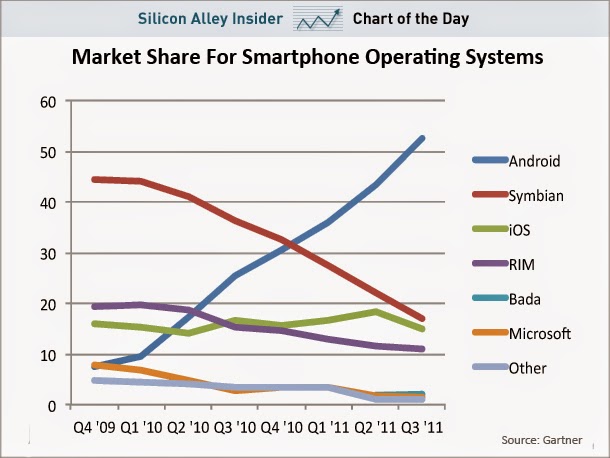
Android: Android began in 2003 as a secret project to make digital cameras and cellphones smarter. In 2005, it was acquired by Google and became the foundation for their mobile Operating System (OS). In 2007, Google launched the Open Handset Alliance which is a consortium of phone manufacturers, cellular carriers, chipset manufacturers. These companies mutually agreed not to sue each other for patent infringements and to refrain from developing on incomplete forks in the Android development chain.
About this same time in 2007, Apple released their first iPhone. Apple chose not to be a part of the consortium, but to compete against Android using patents and Intellectual Property rights to protect their innovations (many of which were taken from the Android).
Apple started off with a good chunk of market share, primarily due to getting a better product out to market faster. They held on as long as they could, but in the end it was one company doing all the software and hardware development vs. the rest of the world. The inevitable result is illustrated in the graph below as well as in this story in
Business Insider.
There are plenty of other examples where Fully-Distributed Networks are making the big monopolies, oligopolies obsolete. The most notable is how email has just about completely
destroyed the U.S. Postal Service, which only remains in business due to taxpayer subsidies and the fact that it is against the law for other companies to deliver mail.
There is no doubt that the Internet is at the core of many of these new disruptive technologies. While most of us can only access the Internet through an Internet Service Provider (ISP) which is a highly regulated entity, this may not always be the case. For the wireless Internet, many of use our cellphones and/or tablets which are connected to the Internet through a cellphone company like Verizon, Sprint, Vodaphone, AT&T or T-Mobile.
Now there is apparently a device coming to market this winter which will allow you to bypass your cellular company and communicate using, text, voice, using your own miniature "cell towers". Check out the
GoTenna. The concept looks like it could present a new future in wireless communications. While the first generation has a limited range, there is no reason that these devices cannot be networked to send data further, much like the early days of Computer Bulletin Board Systems (BBS) did by hopping data across multiple nodes to get from point A to point B.
There is also no reason to assume that people won't figure out how to use them for repeaters, to extend their ranges all over the world - all without paying for any service whatsoever - free peer-to-peer communications with no ISP, no Cell Phone company. It could totally take place outside of the Internet as well, offering more privacy from the NSA snoops.
What do you think?
What other industries could use some Disruptive Technologies?
Feel free to throw some answers out in the Comments section...