A-Ads

Tuesday, September 2, 2014

Government Collecting Your DNA, Planting Evidence


Now that Labor Day Weekend has passed, police are hopefully standing down from their illegal, but lucrative, DUI checkpoint scams.  How did you do?  Were you one of those who was forced to give up some Blood/Saliva/DNA to police?

Government Claims the Right to Take Your Blood Against Your Will
Reading, PA Checkpoint Collects DNA from Drivers

If you were, you might want to take a look at what cops might be planning to do with it...

Police Conspire to Plant Drug Evidence

Ex-NYPD Cop "We Planted Evidence, Framed Innocent People to Reach Quotas"

Police Informant Caught on Camera Planting Drugs

Cop Charged with Murder Caught Planting Evidence on Homeless Woman


DeKalb Officer Indicted for Planting Evidence

Brooklyn Detective Convicted for Planting Drugs

How about it?  Do you think that the government can be trusted with your DNA in evidence storage?

Monday, September 1, 2014

Fully-Distributed Disruptive Technologies Set to Break Up Big Conglomerates and Monopolies


The key to government control of an industry sector is regulation of large corporations that are the backbone of that industry.  For example, you buy electricity from a local provider.  That provider is a regional monopoly that is highly regulated by the government.  The monopoly enjoys a guaranteed profit without any risk.  Large companies love government regulation because it socializes their risks and they earn guaranteed profits.  This rent-seeking behavior is the driving force of monopolization.

Local electricity providers name their price, and you have no choice but to pay it, for this reason monopolistic businesses are called Price Setters.

In free markets, businesses must sell for what the market is willing to pay since there are many competitors vying for the sale, for this reason businesses operating in a free market are called Price Takers.  Free markets are the exact opposite of a monopoly.  Free and unregulated markets have not really existed in this country for quite a long time (think centuries), but now with the advent of Fully-Distributed Networks, we are starting to see them return and there is nothing the government can do to stop it.

Using our electrical monopoly example...  the monopoly enterprise must generate the power, then distribute it to their customers many of whom are located many miles away.  Transmitting electricity over long distances like this creates losses due to the inefficiency (impedance in transmission lines).  The consumer must pay for these inefficiencies as well as tolerate any regulations that are placed on them in order to guarantee the profits to the utility company.  Those regulations are getting more and more intrusive with lightbulb restrictions, the increased usage of Smartmeters, remote air conditioner cycling, etc.

Now imagine that you had a device in your backyard (and/or on your roof) that produced all the
The DFC300 Fuel Cell pictured here can provide power to 250 homes
electricity you needed, perhaps a combination of fuel cell, solar, and wind technologies.  There would be virtually no transmission losses since the distance to your house is very short.  You have just become a threat to the local monopoly.  Now imagine that everyone had them.  The monopoly would cease to exist despite their guarantee of profit from the government.  This form of peaceful rebellion is spreading through many industries, and for this reason, Fully-Distributed Networks are often referred to as "Disruptive Technologies".

Microgrids are another type of disruptive technology that is on the rise throughout the world.  These usually incorporate a power plant that can power a small neighborhood, office building, or residential development.  Several companies can operate small electrical utility networks that compete against each other.

Larger fuel cells or solar/wind stations can be used for whole neighborhoods.  Imagine if you had the option to buy power from one of several providers or your Home Owners Association.  That freedom of choice in providers that the consumer enjoys forces those utility companies to compete by lowering prices and improving service.


Bitcoin is one of the biggest currently growing and spreading throughout the world and it seeks to destroy or disrupt national and world banking cartels such as the Federal Reserve Bank and International Monetary Fund.


Open Source Development is another example.  Historically, inventors and manufactures sought protection of their ideas from competition in the market through the obtaining of a patent by the government.  The patent grants the inventor a temporary monopoly on their invention for a period of time.  Other companies are not allowed to infringe on the invention without a licensing agreement which usually involves paying a licensing fee plus royalties.

Companies will spend billions of dollars protecting their patents by suing other companies and small inventors for patent infringement.  This behavior wastes resources that could be spent on innovating and improving their existing designs, and also discourages others from making improvements to existing inventions.  Many small inventors are put off by the expense of needing to hire a lawyer to do a patent search before proceeding with their invention, so they are defeated before they even begin.

So, along comes Open-Source Development.  Open-Source Development is a development strategy that does not seek patents, copyrights, or other intellectual property protections.  In fact it encourages competitors to co-develop a product by providing all blueprints, schematics, design documents, software code, etc. to the public free of charge.  Companies that use this development strategy have seen massive increases in the speed of  product improvement, growth in sales, and a massive decrease in legal expenses in trying to protect their invention.  Some examples of this strategy and their effects on the competition are listed here:

Wikipedia:  Anyone can create an entry or edit an existing entry on the online encyclopedia Wikipedia which currently boasts over 32 million articles in 287 languages.  This is over 100 times the volume of the Encyclopedia Britannica.

Encyclopedia Britannica, which was once the largest seller and publisher of encyclopedias ceased publishing their famed books in 2010 after dominating the market for over 240 years.


3D Printing:  Imagine if everybody owned a manufacturing facility that was simple to operate - as
easy as printing out a document on your computer...  That is the future of personal manufacturing through 3D Printing which allows you to print physical objects with plastic or metal.  3D printing is not a new technology - it's been around about 30 years, but it has recently become much more affordable thanks to Open Source Development.


Android: Android began in 2003 as a secret project to make digital cameras and cellphones smarter.  In 2005, it was acquired by Google and became the foundation for their mobile Operating System (OS).  In 2007, Google launched the Open Handset Alliance which is a consortium of phone manufacturers, cellular carriers, chipset manufacturers.  These companies mutually agreed not to sue each other for patent infringements and to refrain from developing on incomplete forks in the Android development chain.

About this same time in 2007, Apple released their first iPhone.  Apple chose not to be a part of the consortium, but to compete against Android using patents and Intellectual Property rights to protect their innovations (many of which were taken from the Android).

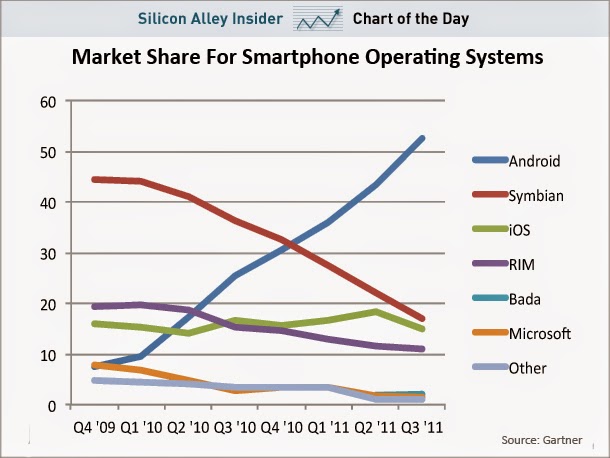
Apple started off with a good chunk of market share, primarily due to getting a better product out to market faster.  They held on as long as they could, but in the end it was one company doing all the software and hardware development vs. the rest of the world.  The inevitable result is illustrated in the graph below as well as in this story in Business Insider.


There are plenty of other examples where Fully-Distributed Networks are making the big monopolies, oligopolies obsolete.  The most notable is how email has just about completely destroyed the U.S. Postal Service, which only remains in business due to taxpayer subsidies and the fact that it is against the law for other companies to deliver mail.

There is no doubt that the Internet is at the core of many of these new disruptive technologies.  While most of us can only access the Internet through an Internet Service Provider (ISP) which is a highly regulated entity, this may not always be the case.  For the wireless Internet, many of use our cellphones and/or tablets which are connected to the Internet through a cellphone company like Verizon, Sprint, Vodaphone, AT&T or T-Mobile.

Now there is apparently a device coming to market this winter which will allow you to bypass your cellular company and communicate using, text, voice, using your own miniature "cell towers".  Check out the GoTenna.    The concept looks like it could present a new future in wireless communications.  While the first generation has a limited range, there is no reason that these devices cannot be networked to send data further, much like the early days of Computer Bulletin Board Systems (BBS) did by hopping data across multiple nodes to get from point A to point B.

There is also no reason to assume that people won't figure out how to use them for repeaters, to extend their ranges all over the world - all without paying for any service whatsoever - free peer-to-peer communications with no ISP, no Cell Phone company.  It could totally take place outside of the Internet as well, offering more privacy from the NSA snoops.

What do you think?

What other industries could use some Disruptive Technologies?


Feel free to throw some answers out in the Comments section...


Thursday, August 28, 2014

Liberation Through Fully-Distributed Networks: Part 2 - 3D Printing


Part 2:  3D Printing as a Fully-Distributed Manufacturing Network.

How Fully-Distributed Networks like Bitcoin and 3D Printing will liberate everyone from the tyranny of monopolies and government.


Liberation through Fully-Distributed Networks: Part 1 - Monopolies


How Fully-Distributed Networks like Bitcoin and 3D Printing will liberate everyone from the tyranny of monopolies and government.


Saturday, August 23, 2014

Cop Publicly States That He Will Shoot You For Walking Wrong

Justin King | The Anti-Media
The Washington Post ran a piece of propaganda written by a Professor in the academically intensive field of “Homeland Security,” you know one of the majors you see on late night TV that’s taught through correspondence courses. He also served the LAPD for 17 years, and the people know how well regarded that particular institution is for its safeguarding of civil rights. Sunil Dutta takes pen to paper to explain to people that the only way they can avoid being gunned down by a cop is to be lead like a lamb to slaughter in any interaction with law enforcement. Image credit: Cris Yarzab (Author of WaPo Op-ed Sunil Dutta not pictured. Generic LAPD photo.)
Rather than let this wonderfully crafted pile of steaming doublespeak go by without comment, the entire opinion piece is included along with appropriate commentary.
“A teenager is fatally shot by a police officer; the police are accused of being bloodthirsty, trigger-happy murderers; riots erupt. This, we are led to believe, is the way of things in America.”
This isn’t what the people are led to believe; this is a pretty good summary of the events.
“It is also a terrible calumny; cops are not murderers. No officer goes out in the field wishing to shoot anyone, armed or unarmed. And while they’re unlikely to defend it quite as loudly during a time of national angst like this one, people who work in law enforcement know they are legally vested with the authority to detain suspects — an authority that must sometimes be enforced. Regardless of what happened with Mike Brown, in the overwhelming majority of cases it is not the cops, but the people they stop, who can prevent detentions from turning into tragedies.”
First, I feel I should compliment Mr. Dutta for his expansive vocabulary. “Calumny” basically means “slander,” for those that don’t want to Google the definition. But it isn’t slander. A teenager was fatally shot by a cop. That’s not in dispute. Here’s a list of other people killed by cops just this month. No doubt that some were justified, but some weren’t. Maybe the officer didn’t wake up that morning and say “Today, I’m going to kill someone.” Maybe he did, but we can’t prove it, so it’s not premeditated. Let’s call it Murder in the Second Degree. Sometimes they kill people just because they “don’t have time” to deal with it. It should also be pointed out, Professor, that cops have the legal authority to detain someone under certain circumstances, not just because they call them a “suspect.”
“Working the street, I can’t even count how many times I withstood curses, screaming tantrums, aggressive and menacing encroachments on my safety zone, and outright challenges to my authority. In the vast majority of such encounters, I was able to peacefully resolve the situation without using force.”
Great, so has every bartender in the country. Your job isn’t that dangerous, stop acting like it is. Your job is less dangerous than being a trash collector. The time of being able to point to the dangers of the job is over. It is also a career path you chose. Journalism can get pretty tense at times too, but when I’m photographing in an area and someone becomes abrasive with me, I don’t get to shoot them with anything but a camera.
“Cops deploy their training and their intuition creatively, and I wielded every trick in my arsenal, including verbal judo, humor, warnings and ostentatious displays of the lethal (and nonlethal) hardware resting in my duty belt. One time, for instance, my partner and I faced a belligerent man who had doused his car with gallons of gas and was about to create a firebomb at a busy mall filled with holiday shoppers. The potential for serious harm to the bystanders would have justified deadly force. Instead, I distracted him with a hook about his family and loved ones, and he disengaged without hurting anyone. Every day cops show similar restraint and resolve incidents that could easily end up in serious injuries or worse.”
Wonderful anecdote. Tell it to Misty Holt-Singh, but you’re going to have to talk really loud because she’s in a cemetery after officers showed so much restraint that their bullets sent her to the grave when she was taken hostage. I’m sure the dozens of other unarmed dead killed this year by cops would love to hear your story. I’m sure they’d love to hear anything at all.
“Sometimes, though, no amount of persuasion or warnings work on a belligerent person; that’s when cops have to use force, and the results can be tragic. We are still learning what transpired between Officer Darren Wilson and Brown, but in most cases it’s less ambiguous — and officers are rarely at fault. When they use force, they are defending their, or the public’s, safety.”
Another standard line the people are told to believe. Cops are just defending the public’s safety. Without the thin blue line, there would certainly be rioting in the streets. Funny, it seems like the thin blue line has caused rioting in the streets. What public safety risk was happening when officers killed Eric Garner? In your 17 years as a cop how many wife beaters, rapists, murderers, and other actual public safety risks did you take off the street? How many times did you initiate violence when there was none when you cuffed someone for illegal possession of a plant, prostitution, or for failing to pay some form of extortion to the state? You aren’t a hero. You’re the armed collection force of the largest extortion racket this country has ever seen.
“Even though it might sound harsh and impolitic, here is the bottom line: if you don’t want to get shot, tased, pepper-sprayed, struck with a baton or thrown to the ground, just do what I tell you. Don’t argue with me, don’t call me names, don’t tell me that I can’t stop you, don’t say I’m a racist pig, don’t threaten that you’ll sue me and take away my badge. Don’t scream at me that you pay my salary, and don’t even think of aggressively walking towards me.”
I am arguing with you. I think you’re a complete idiot. You can’t stop me. Well, I’m a heterosexual blonde-haired, blue-eyed white male; so I don’t have a race card, but I’ll still call you a pig. Make no mistake, if you violate my rights I will sue you and use your badge as a paperweight. We do pay your salary, and your subjective belief of how I am walking is not grounds for lethal force. It’s funny how I can do all of these things to you as a private citizen, but the second you put on a magic blue costume, it gives you grounds to assault and kidnap me.
This passage shows you for what you are: a hired thug. Thankfully, you don’t represent all cops, but it terrifies me to find out you teach future law enforcement officers. Your students now believe it’s OK to shoot someone for calling them names. That is what you just said. I hope you’re tenured because I have a feeling Colorado Tech University is going to get a whole lot of heat for keeping you on staff.
“Most field stops are complete in minutes. How difficult is it to cooperate for that long?”
That’s the wonderful thing about living in a free country, even though those freedoms are currently on life support. We don’t have to cooperate with you. If you don’t want to receive any resistance, don’t ask me where I’m going, don’t ask me where I’ve been, don’t ask me if you can search my car, don’t ask me what’s in my bag, don’t ask how I know my passenger, and don’t even think of pulling a weapon on me.
Most field stops are complete in minutes. How difficult is it to not violate someone’s rights for the length of time it takes to write a ticket?
“I know it is scary for people to be stopped by cops. I also understand the anger and frustration if people believe they have been stopped unjustly or without a reason. I am aware that corrupt and bully cops exist. When it comes to police misconduct, I side with the ACLU: Having worked as an internal affairs investigator, I know that some officers engage in unprofessional and arrogant behavior; sometimes they behave like criminals themselves.”
Of course, it’s scary. You, someone who is attempting to tell people how to avoid getting shot, has already stated that you might shoot someone because you believe the manner in which they are walking is not proper. Scared animals, including humans, have a fight or flight mechanism. Perhaps your cutesy little piece here attempting to scare people into submission wasn’t such a good idea. All you have done is reinforce the idea that it is better to roll the dice and hope the cop can be subdued with force rather than hoping not to offend your delicate sensibilities. Working LAPD’s Internal Affairs just means you were the Gestapo arm of the department. A cop offends a higher up, and you get turned loose. You weren’t out trying to protect the citizens from bad cops; your opinion piece clearly shows the country that even those responsible for investigating cops believe it’s OK to put a bullet in someone who calls them a name.
“I also believe every cop should use a body camera to record interactions with the community at all times. Every police car should have a video recorder. (This will prevent a situation like Mike Brown’s shooting, about which conflicting and self-serving statements allow people to believe what they want.) And you don’t have to submit to an illegal stop or search. You can refuse consent to search your car or home if there’s no warrant (though a pat-down is still allowed if there is cause for suspicion). Always ask the officer whether you are under detention or are free to leave.”
After your little tirade about what is likely to get people shot, you expect them to question their betters and try to exercise their constitutionally protected rights? Are you kidding? You just told the American people in no uncertain terms this is how people end up getting “shot, tased, pepper-sprayed, struck with a baton or thrown to the ground.”
“Unless the officer has a legal basis to stop and search you, he or she must let you go. Finally, cops are legally prohibited from using excessive force: The moment a suspect submits and stops resisting, the officers must cease use of force.”
By this point in the piece I became convinced that you lost a bet and had to write this as a joke. Kelly Thomas’sbrutal murder by cops from your neck of the woods shows this to be a complete fabrication. He submitted, and was still beat to death. The courts provided no justice. Now you act surprised that Americans, having lost faith in the police and courts, are holding trial in the streets. Just as prosecutors offer defendants life sentences to get the plea in order to avoid the death penalty, people have come to realize that it’s better to kill a cop and go to prison than be beat to death while begging for their father.
“But if you believe (or know) that the cop stopping you is violating your rights or is acting like a bully, I guarantee that the situation will not become easier if you show your anger and resentment. Worse, initiating a physical confrontation is a sure recipe for getting hurt. Police are legally permitted to use deadly force when they assess a serious threat to their or someone else’s life. Save your anger for later, and channel it appropriately.”
Legality has nothing to do with this anymore. Officers that fail to abide by the law should expect resistance. It may not be wise, but it’s better than bleeding out in a car while the cop delays medical treatment so there is only one story of the chain of events leading up to the shooting. Police departments across the country have made the choice to militarize and enforce unjust laws. Don’t be surprised that people have decided to meet force with force. You wanted to play army, well even in the childhood version; somebody ends up lying on the ground. Don’t cry about it now.
“Do what the officer tells you to and it will end safely for both of you. We have a justice system in which you are presumed innocent; if a cop can do his or her job unmolested, that system can run its course. Later, you can ask for a supervisor, lodge a complaint or contact civil rights organizations if you believe your rights were violated. Feel free to sue the police! Just don’t challenge a cop during a stop.”
Your advice is submit to sexual assault, harassment, deprivation of rights, assault, or whatever the officer decides to dish out, and then contact his supervisor who will probably laugh while he watches the dashcam video before it is erased and the statement goes out that the camera malfunctioned. No thanks. The American people have tried that for long enough. It doesn’t work. Your thin blue line has created a backlash.
“An average person cannot comprehend the risks and has no true understanding of a cop’s job. Hollywood and television stereotypes of the police are cartoons in which fearless super cops singlehandedly defeat dozens of thugs, shooting guns out of their hands. Real life is different. An average cop is always concerned with his or her safety and tries to control every encounter. That is how we are trained.”
Stop. We have all seen the stats. It is not that dangerous. A fisherman has a more dangerous job. Real life is different than the movies. The cops in movies know better than to shoot into a car with hostages, they know better than to shoot unarmed people, they don’t rape “suspects,” they don’t run pedophile prostitution rings, and they don’t flash their guns at sorority girls buying bottled water.
“While most citizens are courteous and law abiding, the subset of people we generally interact with everyday are not the genteel types. You don’t know what is in my mind when I stop you. Did I just get a radio call of a shooting moments ago? Am I looking for a murderer or an armed fugitive? For you, this might be a “simple” traffic stop, for me each traffic stop is a potentially dangerous encounter. Show some empathy for an officer’s safety concerns. Don’t make our job more difficult than it already is.”
If you can’t handle these things without violating people’s rights or shooting unarmed people, then you are in the wrong line of work. Maybe you should take up teaching or something. After all, those that can’t do, teach.
“Community members deserve courtesy, respect and professionalism from their officers. Every person stopped by a cop should feel safe instead of feeling that their wellbeing is in jeopardy. Shouldn’t the community members extend the same courtesy to their officers and project that the officer’s safety is not threatened by their actions?”
This is all true, but now that police use fear as a weapon and attempt to intimidate the populace with armored vehicles, black uniforms, no-knock raids, military tactics, and propaganda pieces in the Washington Post that basically say that they can do whatever the hell they want, the people don’t want you to feel safe. When you behave like an occupying army, expect resistance. The police chose this route, not the people. When people are subjugated by an oppressive control system, they will find a way to dismantle that system. They will exhaust all other options, but then they will use violence. Until police departments remember who pays their salary, I’d suggest you keep your schedule clear for more of your friends’ funerals, because communities across the country are tired of burying people because cops have declared war on the American people.
This article is free and open source. You have permission to republish this article under a Creative Commons license with attribution to Justin King and TheAntiMedia.org. Follow us on Facebook and Twitter to receive our latest articles.

Wednesday, July 30, 2014

Recent drop in Bitcoin price

So, if you haven't noticed, the price of Bitcoin has dropped about 10% in the past week or so.  It's down from about $630 to the $570 range at the time of this writing.

Usually there is some big story to explain a big move in price, but this time it's really not easy to find.

The Bitcoin haters and skeptics are out writing about how Bitcoin sucks and this is the triumph of big central banking over anarcho-capitalism and freedom.  They have been saying this since Bitcoin was at $0.001 each.

One article that made the most sense of it to me, explained that one of the biggest complaints of the haters and skeptics is the volatility in Bitcoin price.  It would move as much as 10% up or down each day.  This made it difficult for the old farts on Wall Street to think of it as a "legitimate currency".  Though currency traders like the people on Forex, love it because volatility is how you make money as a trader - you can't buy low and sell high if the price is the same all the time.

Finally, this year the price of Bitcoin stabilized and what did the haters do?  Hated on it more... articles about how it won't last are all over the net.  They then lamented for the traders who can't make money because the price is too stable.

The Market Capitalization (value of all the Bitcoins in circulation) for Bitcoin is about $8 billion roughly, while that may seem like a big number, as far as currencies go, it's not that big.  That means that big traders can move the price pretty significantly.  Let's not forget that the government just auctioned off those 30,000 Silkroad Bitcoins that they stole from the (alleged) Dread Pirate Roberts.

The article goes on to speculate that the reason for the price drop is because of the recent stability, the Bitcoin traders are shifting over to more volatile currencies (crypto and otherwise).  So, it stands to reason, that with the return of price volatility will come more traders coming back into Bitcoin trading, which will bring the price back up.  The hard part is guessing where the bottom will be.

If you look at the big picture, this drop is insignificant compared to past price volatility.  People got used to the recent stability, which really only lasted a couple months.  Let the haters hate, they're never going away.  Some are speculating that the bottom will be in the $350 range.  I don't think it will drop that much.  If it does, that's simply a good time to buy.  Bitcoin will find a bottom and come back up.

Remember, buy low, sell high.


Tuesday, July 29, 2014

Apple vs. Bitcoin

Apple is finally and reluctantly getting on board with Bitcoin and this clearly illustrates how their outmoded way of thinking is killing them.
After banning and removing all Bitcoin related apps from their Appstore, they are now slowly starting to allow a few of the big ones on-board.

Unlike Android, Apple has complete control of what is allowed to be sold in their Appstore.  They decide what apps you're allowed to purchase and what you cannot.  They have also fought efforts to jailbreak their phones or sideload apps from sources other than the Appstore.

Why is Apple opposed to innovation?
Apple claims that their reason for pulling Bitcoin-related apps was due to the Silk Road bust.  Silk Road was a pirate website, that provided a market for all sorts of illicit products and services that could be bought with Bitcoin - everything from music, movies, and games to drugs, hookers, and hitmen could be purchased anonymously using Bitcoin.  The alleged operator of The Silk Road, the Dread Pirate Roberts, was arrested in 2013 and his home raided.  Feds seized computers with coin wallets containing over 30,000 BTC.

But, Bitcoin is not the only currency used to commit these so-called crimes.  While 30,000 BTC is a sizable amount of money, it pales in comparison to many other busts involving credit card fraud, drugs, etc. in which the criminals used Dollars, Euros, Pesos, or Rupees - yet no bans on apps that use these currencies or credit cards were even considered.

The Bitcoin architecture is a fully-distributed network.  It is based on the exact opposite of this Command and Control mentality, which is probably why it frightens the folks at Apple.  Apple has always been about design over innovation.  When they carried the largest share of the Smartphone market they acted like tyrants - dictating what people can and can't do with their devices.  Those days are gone, and Apple's market share is average, though they still act like they control the market.

By using open-source code and a totally free market, Android has completely surpassed Apple leaving
them far behind.  Android's market share for the 1st quarter of 2014 checked in at over 81% and it's still growing, while Apples IOS has been stagnant and trending slightly downwards.  Apple IOS checked in at 15.2% for the 1st quarter of 2014, down from 17.1% in the same quarter the previous year.

What makes Android so much better than IOS?  Both operating systems are very powerful.  Some would argue that they are almost equal utility, yet Android completely dominates in sales.

The difference is that Android is not centrally controlled.  It is an open-source and provides a free market for app developers.  Android vs. IOS is basically Free-Market Capitalism vs. Command and Control Socialism.

Bitcoin is a system of Free-Market Capitalism for money that is independent from central banks and government.  If we were to draw a graph of Bitcoin vs. U.S. Dollars (or any other government-sanctioned, central-bank currency) it would look like the Android vs. IOS graph above- although we are only at the very beginning.

As Bitcoin continues to gain momentum, the government currencies will become more and more irrelevant.

Related Reading:  
Forbes: Why Apple is Afraid of Bitcoin
Digital Trends: Bitcoin Users Smash Their iPhones after Apple Bans Last Bitcoin Wallet From Appstore
Apple Warms Up To Bitcoin with Reintroduction of Blockchain on Appstore